The following essay by Jacqueline Gens is reprinted from the catalog of
The Tibetan Literary Exhibit, Smith College, 2007 in honor of HHDL's visit on campus in May 2007. The essay was commissioned by the curator of the exhibit, Marit Cranmer to address women poets of Tibet. Smith is also my alma mater ('81).
Over the past fifty years, the Western world has been introduced to an ocean of Tibetan literature still unfolding its treasury of knowledge. New titles appear annually on both spiritual and secular topics as the first generation of translators have become seasoned mediators (and meditators) between this ancient legacy and contemporary interest. At the same time, many Tibetans have themselves been introduced to Western languages. Their writing continues to evolve with the emergence of contemporary literary genres both inside Tibet and in exile. Fresh perspectives on the scope of Tibetan literary arts will deepen with further acquisition, cataloguing, digital preservation and scholarly attention to ancient writings.
Among poets across time and space from antiquity to the present there is the unspoken hermetic tradition of art as a common quest for personal transformation via language, a journey more about unknowing in the contemplative sense than mere intellectual certainties. The universal appeal of poetrymind and its endless variations is no less apparent in Tibet than any other world culture. Sandwiched between the two great civilizations of India and China, Tibet’s literary contribution to humanity looms distinct—increasingly so, as contemporary scholars reevaluate Tibet’s indigenous origins and recast history according to the literary and archaeological record rather than political or doctrinal agenda.
An essential Western approach to versification favored by modern poets is categorized as phanopoeia (image), melapoeia (sound) and logopoeia (mind). Here, within the texts curated for this exhibit, we find abundant representation of this tripartite classification. In translation, representations of pure melapoeia may prove compromised without the original sonic elements of rhythm and assonance. However, this is mitigated by the understanding that in the original language where much of Tibetan verse was sung, there follows Louis Zukofsky’s diagram “upper limit music, lower limit speech.” The sheer exuberance of Tibet’s longstanding fascination with the nature of mind and the process of thinking itself, framed by the figurative language of the majestic Tibetan landscape alone, should place Tibetan literature on a par with other world literatures. It’s natural then that some Western poets have already looked to aspects of Tibetan poetry for inspiration (Ginsberg, diPrima, Waldman, Quasha, Giorno, LLLevi), where consciousness and phenomenal interconnectedness via spontaneous composition have become primary considerations of post modern literature with verse being the natural extension of the poet's thought via the medium of breath.
For millennia Tibetans have composed poetry found in folk song (glu) and drama (ach’e lhamo); verses of great antiquity discovered at Dunhaung (snyan rtsom); the Gesar of Ling epic (sgrung) tradition sung spontaneously in metered verse; mystic songs of spiritual experience associated with tantric rites and the works of numerous practitioners such as Milarepa and Shabkar and others well into the modern era (nyams mgur); elaborate compositions based on the intricate Kavya training in versification emanating from the monastic colleges (snyan ngag me long ma); the Terma tradition of writings rediscovered in the mindstreams of future revealers (gter ston pa); and a host of native oracular traditions. From the lowest social strata of unlettered folk to the hierarchical pinnacle of Tibetan society these works were sung, spoken and heralded through the streets, encampments, monasteries, charnel grounds, caves or, in some cases, whispered in secret from generation to generation between master and disciple. Remarkably, a huge number of these compositions manifested as text through the labor intensive printing technologies unchanged for centuries and survive into the present.
Yet the presence of Tibetan women’s literature remains dismally but a small stone in this gigantic edifice of oral and written material. As a poet looking to the tradition searching for female voices, there is a marked lack of historic individuals toward to turn. One might hope that some cave or private household library may still yield a cache of lost writings of a Mira Bai or Sappho, or even an ordinary woman, however fragmentary, as happened with the discovery twenty years ago of Tang dynasty poets thought to be lost forever, in the attic of a barn in Xi’an where it lay undisturbed for over a thousand years. As recently as the 1960’s during China’s cultural revolution, numerous texts throughout Tibet were hidden in caves or buried where they would not be disturbed. It is hard to believe that in such a sophisticated mind culture as Tibet there are so few women authors. Still, a small stone casts its ripple.
Whether the work of women simply did not exist due to illiteracy, social circumstance, or lack of encouragment, can only be surmised, More likely, their work was considered of less importance and therefore not recorded or saved out of an androcentric preference but nonetheless existed at least in limited forms. There is some evidence that in the translation from Sanskrit to Tibetan, the gender of some female tantric lineage holders was altered linguistically when they entered into the Tibetan canon. However, what can be acknowledged is that the feminine principle itself is highly regarded within the Tibetan literary tradition as a matrix for personal transformation to which untold numbers of men and women staked their personal journey for realization. In her groundbreaking book, Women of Wisdom, Tsultrim Allione recounts the lives of a number of female Tibetan adepts. One such yogini, A-yu Khadro Dorje Paldron told her life story to Choegyal Namkhai Norbu, who by his own admission, uncharacteristically for a Tibetan, recorded her story while still a young man. Her biography is a thorough account of the social milieu in which such training and practices were undertaken equally by both men and women outside the established monastic colleges. This particular female biography (nam thar) indicates a legacy of writings and spiritual songs left behind by A-yu Khadro upon her extraordinary death. Perhaps her work was lost in the chaos of mid-century diaspora and cultural ruination but nonetheless the mere mention of such writings as existing signals encouragement for future scholars.
It will be generations before the full impact of the possibility for identifying unknown works by Tibetan authors might reveal themselves: lost manuscripts or folios discovered and reassembled, the puzzle painstakingly put together, clues followed up on the names of disciples of famous masters and oral histories taken in remote locations. Perhaps what is lost or non-existent will never come to light. One thing we know for certain is that there are at least some women’s voices from Tibet’s past to consider. Given that the first female institutions of higher learning first occurred in America in the 19th century, it is simply a miracle that the 11th century Machig Lapdron, a renowned reader of the prajnaparamita texts in her own time, wrote volumes that were preserved, even brought back to India and whose liturgies are still practiced today in an unbroken lineage.
Machig Lapdron’s (1055-1143) lineage of Chod exemplifies the highly sophisticated understanding of the cornerstone of the Mahayana teachings on emptiness and the illusory belief in an ego. In Buddhist philosophy, the ‘conceit’ of ego is perceived as the ultimate demonic force and obstruction to liberation. Fully comprehending this view releases the practitioner into a field of compassion whereas the psychical/physical becomes a means to feed the illusory demons of the mind’s projections thus embracing rather than rejecting negative forces through repression. Eighth century, Yeshe Tsogyal, an earlier incarnation of Machig Lapdron, in her parting advice incants these words, “I have yet to find any ‘thing’ that truly exists.” On the other hand, Nangsa Obum, a contemporary of Machig Labdron and famous “delog” draws on the metaphor of weaving, a traditional women’s occupation, to illustrate the stages of the path to realization in a famous folk drama widely known throughout Tibet. Her song in many ways closely parallels the tradition of Terighati (songs of the nuns from the time of the Buddha) drawing on the immediacy of her domestic life. However slender, these representations are but ciphers in a larger cultural context.
An aspiring Tibetan language student once asked the late Tibetan master, Chogyam Trungpa (1939-1987); “What do you really need to learn Tibetan?” “A new mind.” Tibetan culture, in general, has something to tell us about how a civilization can manifest so much wisdom and compassion with so little material culture, how the primacy of personal liberation stands in stark contrast to our own preoccupation with material advancement. Tibetan literature expresses a culture infused with a passion about mind and it might be interesting, even profoundly useful, for us to consider what such a society might be like in terms of human development and to listen deeply to what they have to say. Applying a new mind in search and research of Tibet’s literary treasures may well yield a few surprises and voices awaiting our notice, including those of women.
(sources on request)
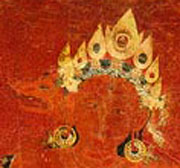
Image from the Rubin Collection, NY