Thursday, May 04, 2006

Harry Smith (1923-1991) OLD WEIRD AMERICA


Harry Smith was among the most interesting people I met while working for Allen Ginsberg, but a royal pain. Around 1986/87, Allen brought him out to Naropa in Boulder, Colorado to live where I was then working as a director of marketing and publications overseeing five departments. Previously, I had worked for the summer institute especially the Jack Kerouac School of Disembodied Poetics that ran a 4-week program each summer. The college had just purchased a property adjacent to the school which had several small cottages subdivided into two apartments each. Harry was given one of these apartments for his residence. His health was already deteriorated due to many years of abuse. Somehow, I ended up as the official go between managing Harry's affairs and Allen who funded him from NY during the school year. Eventually Rani Singh, a Naropa student rose to the occasion, and took over, much to my relief. Later, Rani would develop the Harry Smith Archives and devote herself entirely to him for the last few years of his life. There was a period of overlap where we both were involved. I have one vivid memory of the two of us checking out Harry's freezer one day and finding some frozen underpants among other non-edible items ( I think they were Allen's, maybe Rani would remember). Rani had an infectious laugh, I can still hear.
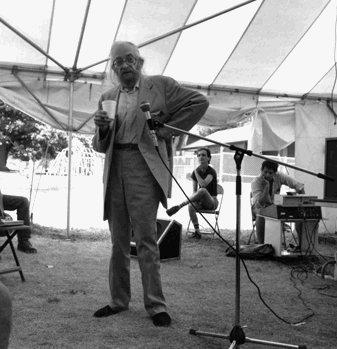
Harry was rather difficult to maneuver for even the simplest activity such as getting him to doctors or helping him file for his ssi benefits and very very bad with money--often spending his last dime on some extravagant book purchase. The pose he's striking in this photo is typical of his stubborn 'dig-in-my-heels' streak. At the time, my job was very demanding while at the same time 1986-87 was the period my mother was dying so I made about 5 trips to New England when I couldn't be there for Harry. I lost my temper with him a few times over his more childish behaviors and eventually Allen had to read (write) him the riot act. I still have a copy of the long letter Allen sent to him from NY which in retrospect, reading it now, seems pretty funny and uncharacteristic of Allen--outlining all Harry's faults accompanied with a precise itemization of every penny he had spent on Harry. Harry, of course, was just another one of Allen's 'dependent' charges--the others being Corso, Huncke, and poet, James Schyler. Fortunately, Rani adored being around Harry. Bringing Harry out to Naropa was a great gesture and worked for a number of years as it allowed Harry to connect with lots of young people who paid him court and learned from him. Many of his lectures were recorded and are available online at archive.org in the Naropa collection.

When he was lucid, Harry had an incredible mind and was knowledgeable about many things. I tended toward his anthropological studies and vast knowledge of American folklore but he collected all sorts of amazing things nobody ever thought of--like the string art of little girls, paper airplanes, barn door keys. He was always making recordings that he donated to the Helen Keller Institute. Some of these recordings were around particular sound themes, such as a hammer, or the sound of different fans or some everyday activity to serve as educational tools for the blind. I haven't really read or heard what became of these recordings so that might be interesting research project. He was very curious about people and their ethnic backgrounds. There was one former Naropa student, Lee Ann Brown, later Steve Taylor's girlfriend, who had grown up in North Carolina. He used to ask her and her sister to sing traditional songs he recorded. Lee Ann went on to become a fine poet, publisher, and film maker. He tried to engage me hopelessly in complex conversations about Allester Cook but by that time I had already done many studies of gnostism and alchemy while a student at Smith and was more into the American Buddhist scene. His spirituality seemed intellectual rather than integrated in any practical way into his daily life. Still, considering what a rascal he could be, sometimes he was exceptionally compassionate and sensitive too. The day my mother died, I left a note on his cottage door saying that I couldn't pick him up for some appointment. Later, several times, he told me he had saved that note and cherished it.
Sometime in 1989 or 1990, Harry moved back to NYC. Rani was in NY too, so she resumed her caretaking of him.I'm not all that good with dates. The Harry Smith Archive probably has an accurate chronology. All during 1989, I lived on McDougal Street with Anne Waldman's dad, John Waldman, cooking his evening meal in exchange for a room in their brownstone (Anne's childhood room). I also started working for Allen around that time as Bob Rosenthal was immersed in a building renovation with his neighborhood association who were gutting an abandoned building and then restoring it. My working for Allen coincided with his first outside office on 14th Street where we rented a suite of rooms from Alene Lee, the inspiration for Kerouac's novel, "The Subterranians." Lots of people came and went through the 47 McDougal Street house then for dinner. Each week, John invited Bernadette Mayer and her family. Harry came lots of times. For Allen's 63 birthday, I made a big dinner at the house where Harry, Robert Frank and his wife June Leif whom I admired very much for their art, and some other younger people too came. I remember sitting around the table after dinner and everyone saying they were on some kind of meds except Allen and me. While I was still at 47 McDougal, Harry asked me out on several 'dates' to see his films at the Film Forum picking me up in a taxi and delivering me home--an unusual departure frm his previous neediness. In retrospect, I think he might have wanted to show me that out there in the world he was respected and not just the wreck I had experienced in doctor's offices or other intimate activities. It was amazing how he cleaned himself up for these excursions wearing a snazzy new trench coat. Gregory Corso also had that capacity--to transform himself to a respectable degree when called for.

It was a great moment when Harry received a grammy for his lifetime achievment award. Allen describes the scene. More to come...

Photo credit: Harry in the Naropa classroom tent July 16, 1988 by Allen GInsberg

Bob Dylan & Johnny Cash Singing "A Thousand Miles Behind" Together : Click Here

Circa 1964 in Casitas Springs, CA, riding the bus to St. Catherine's by the Sea in Ventura with the Cash girls. Once sitting next to Roseanne around the time of "Just Like a Rolling Stone", I asked her if her father knew Bob Dylan. It was interesting to see a small segment in the film, "Walk the Line," devoted to Casitas Springs with mention of Bob Dylan. Casitas Springs was about as backwater a California dust bowl holdover you could find. My mother had the first thrift store there. My parents for a brief time owned "The Purple Wagon Restaurant" in nearby Oak View, another spit as you drive through small California town. Whenever any of the Cash family came in (Mama & Papa Cash owned a trailer park in Oak View), my baby brother would play "Ring of Fire" on the jukebox. The restaurant was one of many ill-fated ventures my parents tried their hand at. It must have been so strange, my father, a famous French Chef, who had once run the Garden of Allah, the Ben Blue Night club and famed Malibu, Holiday House, trying to dish up French culinary classics in a diner setting, a diner painted purple out in nowhere!

Quansit huts lined both sides of the highway in and around Casitas Springs where lots of down and out elderly people lived. leftover from the dust bowl diaspora to California. One of them, Minnie, used to help my mother in her shop. She always seemed breathless with excitement whenever she worked in the store where I sometimes helped out after school. In those days, a high end thrift store was rare, about as rare as a purple diner. The local clients really appreciated my mother's stylish window displays. Later in 1965, when my family moved to New York City, travelling by train accross country, the sale of that store funded our move and a lot more too. I remember my mother, Olga, standing in our kitchen saying that if she failed at the store, her life would be meaningless, or something like that. From then on, she always had some kind of antique or second hand store until her death in 1987.

Not much happened in Casitas Springs. Some days, Mrs. Cash would drive down to the country store & post office next door to pick her girls up from the bus. She was always dressed up--I remember once I saw her in a silver lame pants suit, her hair done in a beehive. Another time, I remember, seeing Johnny slumped over in the front seat while she went inside the post office store. They lived on a hill overlooking the town as a respite from Nashville. The video clip of Dylan and Johnny Cash singing together a few years later that I found on another blogspot this morning reminded me of the connection between them and my rocollections of Casitas Springs. That period must have been really a rough time for those girls who semed so serious and self-possessed--especially Roseanne, the oldest. I had my own family problems too that emerged around then compounded by normal teen age angst.

It was in Oak View a year earlier when I was thirteen, I first learned about Allen Ginsberg. One night getting up to go to the bathroom, I noticed the TV was on, my father asleep on the couch. As I went to turn the TV off, a wildly bearded man with a distinct voice magnetized me. It was Allen Ginsberg on the Les Crane Show. At that moment, my hand still on the dial, I heard the sirens of poetrymnd beckon. Here was the epiphanious moment when I told myself that I wanted to know people like him. Odd how that eventually happened years later. I guess one should be careful what you wish for. The power of Allen's voice just grabbed me out of the blue TV haze. Those years in Oak View/Casitas Springs had their own magic. I wasn't born there but my cultural mind was--my ear glued to the transistor radio my grandmother had gaven me one Christmas, tuning into kindred mindsets out there in the world. The Southern pacifc railway tracks were not too far off and every night I was filled with a longing for something greater. It all begins in the hinterlands, the swamp, among the lost and forgotten, the wasteland, outsiders of no import, the diamond in the rough, the "old weird America" of blues and raw vocals--where one hears the true range of duende soul found in American poetics. Listening to Dylan's radio show brought it all back.

By November of 1965, my family would be living in NYC where my father landed a job as the head chef for the Hilton Hotel and at age 15 I was let loose into the cosmopolitan energies I longed for so much. But I never really forgot those years in Southern California. I'm reminded of C.D. Wright's poem, "Lake Return."

Lake Return
by C.D. Wright

Maybe you have to be from there to hear it sing:
Give me your waterweeds, your nipples,
your shoehorn and your four-year letterhorn jacket,
the molded leftovers from the singed pot.
Now let me see your underside, white as fishes.
I lower my gaze against your clitoral light.

Yeah--that's where the bliss is--white not as in race but in naked mind infused with light. What a line, "I lower my gaze against your clitoral light." Maybe it is about sex but to me it resonates more about body and mind consciousness coming together in the first awareness of greater forces at play.

I'm on a roll here using up my vacation time. Nobody really out there but stay tuned anyway. Next time more on Harry Smith, my karmic debt to Allen.

Wednesday, May 03, 2006

Hey, Allen--The Sun is Shining: Bob Dylan on Xm Radio

It’s already been a month since Glen died. On April 4th, the previous night, I had visited the local Shambhala Center in Brattleboro a few blocks from my house to celebrate the 'parinirvana' of Chogyam Trungpa, also the day Allen died nearly ten years ago. He’s been on my mind lately so decided to include “Visitation” in my forthcoming chapbook I've been working on:

VISITATION
For Allen

A few days later I saw you
seated at a dusty crossroad
looking toward a vista of waterways
reminiscent of a cranberry bog or saltwater marsh
I once visited, maybe the river Styx.
A geography of immensity without habitation

where you sat on an old wooden stool,
pored over books and papers, focused intently.
One air of familiarity—your Calvin Klein
Goodwill navy blazer, my favorite;
your pens poking out from the pocket.
I stood quietly to your side waiting to assist you
yet not disturb your concentration.
Finished, you handed me a sheaf of papers,
Here, these are for you—for translation.

Then, you got up and walked slowly down the left-hand road.
I followed but you turned to me and said,
"This is as far as you are allowed to go, I don’t have the water rights
for your passage" —
a hitch of sadness in your voice, your face mostly
impassive, Bell’s Palsy, making one eye bigger, your face a bit cock-eyed,
but looking straight on as we finished our business together once again
in clarity and respect, our natural elegance hanging there a second
as we stared at one another.
I watched you walk off and knew that you were finally gone
on some other journey, to some other place.


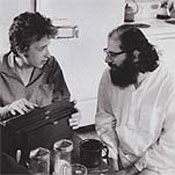
Dylan's theme-time radio show debut yesterday morning on XM radio's Deep Tracks station delivered the kind of smarts, warmth, and expansive presence so absent in current media. We're not talking here about a quaint ole time radio show like "Prairie Home Companion" but a magnanimous reach for the underbelly of American music-- Harry Smith at Allen's kitchen table circa 1988

"Old Weird America," folk scholar, Harry Smith called it. Don't let Dylan's folksy accent kid you. He's erudite and comfortable with it too. His consonants sounded as crisp as ever. Dylan, if nothing else, is a master of elocution. Listening on that dank and rainy spring day in Brattleboro to Dylan's show on "Weather" with him asking the audience if it was raining here too was a bit of magical synchronicity.

I'm sorry Allen isn't around to experience Dylan's graceful shift into old age--the "Chronicles", "Masked and Anonymous", "No Direction Home", now his theme-time weekly radio show on XM. Seeing Dylan at last coming to terms with his fame would have eased his mind as he worried that Dylan found it all too concrete unlike himself. During the years I worked for Allen, there were many precious moments but one of the two times I wished I had a tape recorder was on my 40th birthday when Allen made dinner for me (or rather Jack Shiu did) inviting friends Ellen Pearlman and her Tibetan husband, Tsonam, to join us squeezing us all around his four-sqaure kitchen table in the East 12th Street apartment. That night, he played host bearing books to the dinner table to introduce Tsonam to Cezanne. Later after the guests left, Allen started playing Dylan records--all of them for hours, commenting on phrases here or there he thought especially exquisite. Here's where I wish I had the tape recorder or took notes. [the other time was driving with Edith Ginsberg, Allen and Bob Rosenthal around Patterson]. He loved Dylan, I think more than anyone--for his brilliance. In "No Direction Home", Allen's commentary is heart breaking. Seeing him already so ill-looking was a shock. His comments about Dylan as a "receiver" were faithful to his long recognition of Dylan's literary genius which he perceived as amounting to a quintiessential archytype for poetrymind.

In the office, we were always a bit amused how unusually "ga-ga" Allen would get when talking with Dylan on the phone.As far as I know, Dylan was the only one who commanded such reverence. For our pleasure, Allen would put their calls on speakerphone. Late in 1994, after work one night he took me with him to a concert at the Beacon Theater where we went back stage. In previous years, Bob Rosenthal and Peter Hale had the privilege. One of the telling signs about Dylan is that his staff has worked with him for years. Diane Lapson, one of the co-producers of the radio show, brought us back stage where that particular show Dylan wasn't seeing many people. That might have been the last time they saw each other, I'm not sure. Bob Rosenthal woould know as I left NYC about two years before Allen died. Somehow that event made it into Barry Miles revised bio from a journal entry Allen made later that night....they had bantered back and forth about—Gregory Corso, Blake, the room was dark and lit with a candle with Dylan sitting on the floor and Allen in the only chair. Did I imagine this? The first thing you notice about Dylan is just how smart he is. At one point, Allen said to Dylan something like, "“If you want to know about Buddhism, ask her" which embarrassed me. Dylan laughed harshly saying something about a laughing Buddha bar in Kansas City. I must have jumped or reacted in some way because then Dylan flashed his dazzling smile, the same one his audience would get a momentary glimpse of at the end of his set later that night at the Beacon--—a few seconds of blazing sunshine, a gift from the poetry muses or devas and dakinis we mortals can only take in small increments. Yes, the sun is shinning these days...Thanks, Bob & Company. Hope Harry, Allen, Gregory and all our departed are taking a break to tune in!

See You Later, Allen Ginsberg

Photo credit copyright by Dale Smith, 1965 at TEXT
Photo creditof Harry Smith by Allen Ginsberg circa 1988

Friday, April 07, 2006

Glen Eddy (1941-2006)


On April 5, 2006, Glen Roger Eddy, a long time student of Chogyal Namkai Norbu and member of the International Dzogchen community died of a stroke in Cordoba, Argentina.
Born in San Francisco, California on May 17, 1941, Glen was among the first wave of Westerners to become engaged by Tibetan Buddhism in the early 1970’s. His formal training as an artist began at the San Francisco Art Institute. Later, he was introduced to Tibetan art at Pema Ling under the direction of Tarthang Tulku, eventually studying Tibetan art with several lineage masters including Tarthang Tulku, Dudjom Rinpoche, Trungpa Rinpoche and Gyaltrul Rinpoche—all who contributed to his knowledge of traditional methods. In 1974, he attended the Naropa Institute’s first summer along with other thanka painters of his generation. Considered by many, a foremost master of Tikse or proportional drawing, his elegant line drawings of yidams were highly regarded and adorned such early publications of Chogyam Trungpa, Rinpoche’s as, “Cutting Through Spiritual Materialism,” “The Myth of Freedom,” “The Dawn of Tantra,” and internally published images for practitioners within the Shambhala community. Images survive of a thanka painted with Chogyam Trungpa, Rinpoche as the central figure that was lost in the mail.

In 1974, he married Terri Parkin with whom he had two sons, Glen in 1977 and Austin in 1981. They lived together for 14 years in Berkeley and Oakland, California. Glen first met Choegyal Namkhai Norbu with his family in 1983 when they attended an early retreat at a private home in Berkeley.

From 1994-2000 Glen resided in the vicinity of Tsegyalgar in Conway, Massachusetts where he initiated the Golden Vajra Guild at the newly inaugurated Shang Shung Institute founded by Choegyal Namkhai Norbu for the preservation of Tibetan culture. For several years, he served as Gekod living in the schoolhouse with his then wife, Natasha. During that time he was commissioned by Choegyal Namkhai Norbu to create a number of large scales thankas representing Rinpoche’s Dzogchen lineage. These include a refuge thanka with Padmasambhava; the Primordial Masters; Ekajati, protector of the Dzogchen teachings; and Goma Devi, one of the ancient 21 Semde masters from whom Choegyal Namkhai Norbu received his Longsel terma cycle of teachings. All of these works remain at the Gar and can be viewed on the Shang Shung website. Among many other private commissions is a large thanka with the central figure of Choegyal Namkhai Norbu, as a yogin giving pointing out instructions that was commissioned by John Shane. All these works are available as reproductions through Tsegyalgar’s bookstore.

In recent years, Glen experimented and produced hundreds of mixed-media small scale watercolors for community members-- mostly of Tara, Mandarava, and Goma Devi.
Initially reluctant to create non-traditional works, Glen’s new work was deeply appreciated as it was affordable yet masterful. While at Tsegyalgar he created dozens of line drawings that were reproduced in the Mirror and Shang Shung Editions publications for practice booklets and in publications by Choegyal Namkhai Norbu. Many community members and gakyils over the years were enthusiastic patrons of his works financially supporting his efforts, so that he could paint fulltime.

An uncompromising artist, Glen focused daily on his work, making his own paints using minerals he collected and ground himself according to the centuries old traditional recipes, as well as executing line drawings and preliminary studies with exacting precision, often consulting Choegyal Namkhai Norbu for accuracy. Over the past thirty years, numerous individuals studied thanka painting with him including Cynthia Moku, Greg Smith and other prominent Western thanka painters. At Shang Shung Institue in America, the Golden Vajra Guild, Glen had three main apprentices-- Susan Handlen, Nanji Davison, and Martha Braun.

His thanka works display a radiantly transparent quality as they depict the luminous realms of their central figures rendered in the Rimed non-sectarian style (Karma Gardri) Glen favored that is characterized by a simplicity and spare clarity. Suspended in an ocean of space, the central figures are displayed against a background with minimal rainbows, mountains and streams uncluttered by details typical of other Tibetan thanka styles. The use of hand prepared mineral paints in these works create an unusual palate of subdued color that contribute to the sense of shimmering transparency found in Glen’s work. No one painted like Glen. His mastery of style, palate, and form as a thanka painter reveals a brilliant technique leading to works infused with light befitting the subjects he painted. His line drawings were considered by such masters as Chogyam Trungpa Rinpoche, an artist himself, to be “very special and beautiful.” At the time of his death Glen was working on a step-by-step primer to thanka painting, “The Treasury of Luminous Manifestation,” for what he said, would be the thanka painter of the future a hundred years from now.

It was Glen’s dream that the Golden Vajra Guild become a center for teaching Tibetan art, especially in Tashigar Sur, Argentina, where Glen had retired to build a home and studio for himself that he bequeathed to his eldest son, Hala, also a gifted artist and practitioner in the community who plans to catalog his father’s complete works as a master thanka artist. Austin too is a successful artist in the film industry and along with their mother, Terri Antony, the entire family is knowledgeable about aspects of Glen’s artistic works and processes that we have yet to learn more about.

Glen will long be remembered by his family, many friends and dharma practitioners as a generous and insightful friend leaving behind an important legacy of work for future generations. As a practitioner, he exemplified a deep devotion to Choegyal Namkhai Norbu integrating the profound essence of the Dzogchen teachings in an authentic manner.


Jacqueline Gens
April 12, 2006


* * *

A Celebration for Glen Eddy in his own words


Personally, I will miss Glen Eddy a great deal as I consider him one of my dearest dharma brothers—someone with whom I could always discuss in depth the meaning and application of the teachings in relation to one’s life. He is someone who proved an insightful ally and friend in difficult times. I tried to reciprocate this gesture in return whenever possible, as such friends are rare.

After being out of touch for many months, we recently engaged in a brisk correspondence between January-March 2006 about a variety of topics—the bureaucratic difficulties of assisting him with the paperwork to receive his social security benefits in Argentine, his enthusiastic response to my offer to put together a web site for him and all that he needed to do around this project, and of course, an ongoing conversation about his recent troubled state of mind.

When a friend dies, it is as though a piece of one’s own history incinerates too. Whom now will I share a few unique circumstances of common history-- a bohemian upbringing in Southern California circa 1950’s by difficult European mothers—his Portuguese, mine Russian; our mutual love for poet friend, Allen Ginsberg and appreciation for Chogyam Trungpa, Rinpoche; our shared devotion to Choegyal Namkhai Norbu, the great and kind but sometimes unpredictable master whom we both owed our lives to, finding at last what we were seeking for years.

Glen had a warm domestic side to him. During the time he was gekod at Tsegyalgar living there with his wife, Natasha, I was secretary of the gar for a couple of years. For many months, nearly every night, they graciously invited me to dinner which allowed me then to go back to work for another couple of hours. He communicated a real family atmosphere to whoever was present. Glen made great soups, the true mark of a fine chef. I still remember a bean soup he made as one of the all time culinary events of my life, only to find out later he made it from a box. Sometimes, he would come into the office and chat a few minutes, little gems of humor or odd gossip. But, mostly it was the bond of practice and insights I so appreciated about Glen. Once, when I had gone to Tashigar traveling in the dark with him after some practice back to the little casitas I stayed in across from his own, he mentioned that he had passed a beautiful woman on the pathway earlier in the day but couldn’t tell if she was a real woman or just an apparition. I appreciated this aspect of Glen’s mind—his ability to manage multiple realities with a childlike and open simplicity. On the other hand, he could be quite bilious. So, I am not surprised that in the months before his death he did “not go gentle into that good night," but raged against the dying of the light.

Early in March 2006, hearing through the grapevine that Glen was having emotional and financial troubles at Tashigar in Argentina, I wrote him asking him if he had filed for his social security benefits at the recommendation of some community members who thought it might help his financial burdens. On Mar 9, he wrote back:

“I'm having some kind of mid-life crisis, and I'm in therapy, and
Rinpoche has allowed me to remain in Tashigar, so I'm painting
everyday inspite of my crazies. Sometime I can relate how it is for me, but not this time. I'm feeling good and getting clearer everyday. Now when the tapes start I realize it and can just relax and notice, and it calms down. Sometimes I get carried away for a while. But mostly my days are not too bad…. I’m out of gas, Much love, Glen”

I then responded with a reminder of the co-emergent aspect to his emotional upheavals—that behind every great yogin was a similar experience of shedding baggage. I talked about how it’s never too late for therapy; how courageous he was to face his demons and go into the cellar, very atypical of most men at his age. Having beaten his serious drug addiction once, maybe this was an opportunity to clear up the last vestiges of unfinished business. In previous conversations, we had discussed how to dissolve intense emotions in the moment. Glen understood things well in his bones, not just in words. It seemed that he was handling his state of mind when on March 17, 2006, he wrote back, his last email to me:

“Dear J.
Thanks for the inspiring words.
I am doing really well, I saw my therapist again last night, and she’s really good. I feel great. She also has transmission from Norbu and has been to see Pema Chodron, etc. So she knows pretty much where I 'm at in terms of the Dharma. And she speaks English. And Rinpoche is allowing me to stay in Tashigar. So my balance is coming back. But I have to get to the bottom of this anger thing that I have. It's coming, and my presence and clarity are manifesting like never before. So I feel as you were intimating that this is a good thing. Today I'm actually happy!”

I have no doubt that Glen died an appropriate death and will navigate his way to some purer dimension. A couple of years ago, after I posted a poem on Norbunet, I received a cryptic but stunning poem in return from him that I later incorporated into a long poem I’m still working on. Today, on the day of his death, these words of his seem to me to say everything about the beauty of his mind and his life’s work as a thangka painter that will continue to give so much inspiration to all of us and to future generations of practitioners.

In dreams, they come with out-stretched
hands the color of malachite
giving, magnetizing
palms formed by leaf and wind,
torrential waters--
As they pass to me the white lotus bud
grown up from mud, its stainless bloom
opening.

Jacqueline Gens
Midnight, April 6, 2006
Brattleboro, Vermont, USA

[Photo credit: Ellen Pearlman at Tashigar Sur, Argentina]

Friday, October 14, 2005

from Suzuki Roshi's article "Zen in the Modern World"

"Those of you who wish to discipline yourself in Buddha's Dharma must seek true understanding. When this understanding is attained you will not be defiled by birth and death. Whether walking or standing still you will be your own master. Even when you are not trying to achieve something extraordinary, it will come to you all by itself....

Do you know where the disease lies which keeps you learners form reaching true understanding? It lies where you have no faith in your Self. When faith in your Self is lacking you find yourselves hurried by others in every possible way. At every encounter you are no longer your master; you are driven about by others this way or that.

All that is required is all at once to cease leaving your Self in search of something external. When this is done you find your Self no different form the Buddha or the patriarch.

Do you want to know who the Buddha or patriarch is? He is no other than the one who is, at this moment, right in front of me, listening to my talk on the Dharma. You have no faith in him and therefore you are in quest of someone else somewhere outside. And what will you find? Nothing but words and names, however excellent. You will never reach the moving spirit in the Buddha or patriarch. Make no mistake."