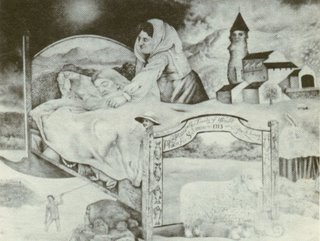
Monday, February 19, 2007

Year of the Fire Pig


Greetings for Year of the Fire Pig


“...and long purples
That liberal shepherds give a grosser name,"
Hamlet, IV vii 170


What’s not to reconsider in grosser terms?
Disarrays— a casual display of hungers
unabated or stout limbs to follow long afternoons
in nothingness where we dally no where
to the larger world of perfections. or split hairs
of judgement. Let’s not forget that our design
is on the other side of civility--
Cracked open: a hue of fruit, its juice
rooting our place in the cosmos,
only to settle on the bud with a taste of eternity.
It’s the long purple we stroke into being:
Wild snouts aflame,
urgent FIRE PIGS
with noses to the ground
searching for the root.

Jacqueline Gens
Brattleboro, Vermont
February 19, 2007

Sunday, February 04, 2007

Stephen Warrren Curtis 1946-1996

This past month I spent 11 days at the Northfield campus of Mt. Hermon Northfield School where we held our annual winter residency for the New England College MFA Program in Poetry that I co-direct. Being in Northfield, MA after nearly 30 years brought back many memories. Little has changed since I went to high school there graduating in 1968. It seems that even the cracks in the road were the same. My first husband, Stephen Warren Curtis, was born and raised in Northfield. I recently came across a website (click on the title) with his art work that my brother, Will, forwarded to me. Being on that abandoned campus, one of our faculty called, a “Wuthering Heights” experience (Steven’s favorite book), brought me back to my late teens and how formative those years were.


I was married to Stephen Curtis from 1969-1971 or 1972 (legally until 1982).Here I am in a photo booth shot the year I met Steven looking a bit like Madame Blavatsky. All of the works on this website by Steven were executed during the time we lived together in Bernardston, Massachusetts which subsequently were incorporated into an offset pamphlet that Stephen created. For years I would find the pamphlet in odd places such as in a storefront window in Harvard Square. I recently heard from Clayton Campbell that when John D. Merriam (Stephen’s primary collector) died his collections went to the Wiggins collection in Boston.

Both my grandparents were visual artists by profession and so marrying an artist seemed an obvious choice. Stephen and I were very inexperienced in terms of relationship, so things were always on shaky ground. I was 19 and he was 24 when we married in April of 1969, Originally, I had just wanted to run off to Boston with him but my mother pressed us into getting married and moving in with her as she liked Stephen quite a bit. In the end, that proved counteractive to my own desires to leave home and get out into the world. On the other hand, things happen for a reason, and this period of my life, while extremely difficult, proved rich inwardly setting in motion the direction I’m still uncovering today at age 57, decades later.

Like many of his friends, what I most enjoyed about Stephen was his integrity and total dedication to his art, as well as his quirky sense of humor, I was not surprised when I heard that he was found dead sitting up in a chair with a book opened on his lap to Ingress, a lifetime influence of his. While we were married, a local doctor whom he had once consulted, Dr. Failla, told him he would be dead at the age of 54 of a heart attack unless he changed his diet and lifestyle. I had heard that he tried to do this in his later years but I doubt he ever made it to the gym. By nature he was sedentary and genetically probably disposed toward high cholesterol. His family was poor and he grew up on comfort foods from the get go, — primarily of the white kind—wonder bread, potatoes. On the other hand, it seems that he died peacefully gazing on his most beloved vision of perfection.

Like Stephen, I had gone to Pioneer Valley Regional High School
In Northfield, MA when my family moved to Bernardston, MA in my senior year. His class would have been about 4 or 5 years earlier than mine. Prior to then, we had lived in Southern California and New York City. Our cultural backgrounds were totally different—mine first generation, eastern European and French, Catholic—his, generations of New England hardscrabble.

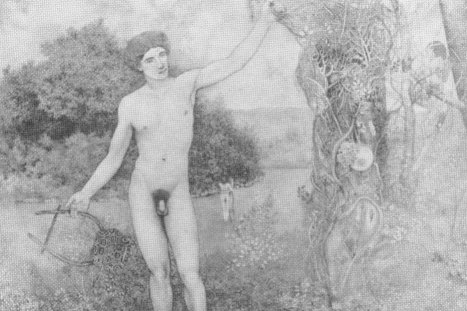
But Stephen had his guardian angels growing up—mainly the lively St. Clair clan of 88 Main Street Northfield who shared their somewhat magical family life with him supporting his artistic talents throughout his youth. One of the few changes I found on Main Street in Northfield was that the old rambling mansion of 88 Main had been replaced by a modest housing unit. Many of Stephen’s works were inspired by his muse, Eva (who later married the artist, James Langlois), one of the beautiful St Clair sisters, who can be seen in some of the drawings featured on the website.

Nonetheless, we had a lot in common on the psychic level as both of us lived in the shadow of early childhood iconic influences and family dysfunctions (a word not much in use back then). Yet, both of us we able to discuss serious issues like sexual abuse and homosexuality, at a time when there was little public discourse happening about these rather taboo topics. That is another aspect of my relationship with Steven that I appreciated. From Stephen, I primarily learned to draw on this energy for artistic sustenance rather than rejecting it as shameful or an unwanted intrusion, He also introduced me to many writers although I was fairly well read by the time I had met him. While married to him, I read the entire works of Carl Jung, Joseph Campbell, and Eric Neumann whose works enriched my interests in anthropology and comparative religion eventually bring me to Tibetan Buddhism. One present he gave me was the complete works of Ezra Pound. These authors probably came to him via Yglesias, a popular professor of comparative literature at Brandeis, about 10 years his senior and a great influence on Stephen intellectually and later for me too.

So in retrospect, I’m very happy that I married Stephen because through him I learned a lot about the creative process and the unfolding of my deeply intuitive nature that I had tried to suppress throughout my childhood. On the practical level, we kept very different schedules. He would work all night until about 5:00 AM in the morning while I would sleep. I supported him and my family to some extent by working the second shift at a plastics factory. Back in 1971, it was still possible to feed an entire family of six for a week on $25 worth of groceries. I earned about $60 a week. As my family tended to be somewhat bohemian, this worked well for a while but after some time I found the regiment of factory work boring and unfulfilling for me personally. But it never ceased to amaze me when I would check in to his studio the next day after he had gone to bed, that he had worked hours on rendering some small detail of a drawing to perfection whether of a head of romaine lettuce or some fantastical being not of this realm. Many of his works started up as murky sketches, messes really, that would become jewels of crystalline clarity through his use of plain graphite on paper.

Unlike Stephen and his circle of male artist friends (Jimmy-Joe Langlois, Mark Spencer, Clayton Campbell, his mentor Luis Yglesias), I had not gone to College, nor had anyone in my family. In the mid-seventies after Steven and I separated, I would return to school eventually earning my BA in classics from Smith which I attended from 1978-1981 as one of the first Ada Comstock Scholars—waitressing and bartending my way through school while hitch hiking to class from Packer Corners Farm where I then lived.

Following my graduation, I legally divorced Stephen who was living in Boston since I was planning to move to Boulder, Colorado to pursue my interests in Tibetan Buddhism and language at the Naropa Institute. By then we had little contact or shared interests although we usually stayed in touch by phone every couple of years. In 1998, while working on a conservation job at the state capital in Madison, Wisconsin, I tried to call Stephen. But his number was disconnected. I then left a message on Beatrice St. Clair’s phone asking about him. Beth Backman (nee St. Clair) kindly returned my phone call to let me know that Steven had died a couple of years before. I eventually visited her a few times to catch up on Stephen’s life.

A lot of my journey does not include Stephen as I went on to live a few years at Packer Corners Farm (Total Loss Farm, his then friend Luis dubbed it), an altogether other story, then on to Boulder for 7 years where I worked at Naropa Institute in the Jack Kerouac School of Disembodied Poetics, on to NYC for another five years to work for the poet, Allen Ginsberg, then back here to New England where I’ve been in Brattleboro, Vermont since 1995. For the past 25 years I’ve been a student of Tibetan Buddhism primarily of Chogyam Trungpa’s (1939-1987) Shambhala lineage and the Dzogchen lineage of Choegyal NamkhaiNorbu.

On a rare note of curiosity one day, the poet Allen Ginsberg once asked me when I visited him at Lenox Hospital (circa 1987 when he had his gall bladder removed) about my early influences. Across from his bed was a reproduction of the girl with a watering can by Degas. I flashed on living with Steven nearly two decades earlier where once I had made a collage out of the girl with a watering can by meticulously cutting out a picture of Bob Dylan’s head and superimposing it on the Degas image that hung in our dining room for years. At the moment, Allen was thrilled with a hugely lush bouquet delivered to his room he had just received from Dylan’s office. “I took the left hand road” I told Allen that day, ” and never regretted it”. “Me too” Allen said. The day I married Stephen was the day that I took that decisive turn in the road and it led me to where I wanted to go.

At the heart of Stephen’ s work and his colleagues in the school of mystical surrealism, is a plumbing for unconscious artifacts emerging into the light of ordinary consciousness. In Steven’s case, there was the paradisiacal return to childhood images found in the Northfield landscape lived in the shadows of Moody’s progressive edifices with its elegant landscape and raw from his family dynamics who worked as servants on the Moody estate for generations. As such, the circumstances of Steven’s birth and his pedigree provided the classic ingredients for a “wounding” into artistic presence. As a poet many of the writers I admire come from such backgrounds, growing up out of the swamp, the backwoods, the ruined portal of passage from the lowest social strata to the higher realms of a pure perception through their art.

Although Stephen’s mother, Leolyn Curtis, who had conceived him out of wedlock in the 1940’s always claimed to him that he was the son of her love interest, a prosperous local farmer who had many children, it was widely known within the town that Steven’s actual biological father was an eccentric painter who lived with his mother from one of Northfield’s leading patrician families. Apparently, not only did Steven inherit his father’s artistic talent he exhibited at an early age but his looks as well.

This mixed message considerably shaped his artistic vision in that his work explores the classic surreal ethos that things are not what they seem. Within the sometimes harsh and violent imagery of his work can be found a tenderness, the sadness of Eros or what William Carlos Williams came to call “Unworldly love that can not be satisfied. Like numerous artists before him, he circled this justification of art to make up for life’s impossible dilemmas that can be found in the arcane imagery of the Northfield chateau as a citadel of sanity and home to his erotic interests whether male, female or hermaphroditic who often appear in the guise of mythological figures.
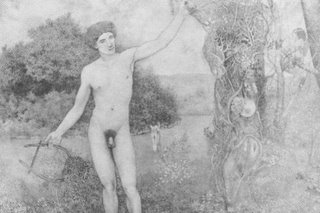
Here is Apollo with his lyre lingering at the tree of Daphne transformed into a rich tangle of foliage, the real lovers embracing in the background in the Connecticut river, the entire scene transposed to Northfield, Apollo’s heart forever broken in unrequited love with an impossible yearning.

I don’t know much about Stephen’s life after the 1980’s except that he worked as a guard at the Museum of Modern Art where I’m sure he engaged in all sorts of conversations with aspiring artists.He was a great raconteur.

In many ways, Stephen’s lifetime achievement was his actual artistic process. It doesn’t matter that he did not become famous or ever have a major show although he certainly deserved some kind of show along with his colleagues. He lived the archetype of the quintessential artist forever beholden to his inner vision to render into worldly terms images that transcend into universal ciphers of tender unworldly love.


Monday, November 06, 2006

Afgani Poet, Nadja Anjoman Memorial

Which plunderer’s hand ransacked the pure gold statute of your dreams/In this horrendous storm?
--Nadia Anjuman, "Strands of Steel"
Dear writers, poets, and friends of literature around the world!
You receive this e-mail on 5th November 06:30 pm CET 2006.
On 5th November 06:30 pm CET 2005, exactly one year ago, we lost last life signsofourfriend and colleague Nadja Anjoman, the Grande Dame of Modern Afghan Poetry.

Few hours later she left us forever…We remind her with a minute of silence and ask you to join us by doing the same, when you receive this mail and read through her biography attached below.
We kindly ask you to forward this message to other poets and writers, and friends of literature, and friends of Afghanistan and ask them to forward this message to other poets and writers...

All of you and those who will receive this mail may send us all your comments and notes in response to this mail, we will collect them and publish on a memorial site and forward it also to her family in Herat.

In remembrance to Nadja Anjoman our friend and companion

Sincerely Yours,Dr. Sam Vaseghi


Audio link:
http://www.exil-archiv.de/audio/anjoman/anjoman.mp3

Poets Biography by Shafie Noorzaei and Ren Powell

_________________________________

The Poet’s Biography


Sub: The biography of Nadia Anjoman, the respected poet of Herat-Afghanistan
and a victim of family violence on 5th Nov., 2005

By:M. Shafie Noorzaei, her brother, lecturer at Herat University
(edited by Ren Powell) Date: Jan 23, 2006

On the 27th of December, 1980 my parents’ sixth child was born. They named her Nadia. As far back as I can remember my parents talked about how the birth of this baby girl enriched our lives. They said she was a harbinger of fortune for my father and his family.

Even as a child, Nadia was clever and intelligent. I remember how, when we were young, she would jump on the stairs at our house. She used to ask me to join her, but being two years her senior, I didn’t understand why she enjoyed it so much. Then again, maybe it wasn’t my age that was the problem—perhaps I didn’t share her unique sensitivity.

When we began elementary school, Nadia and I were in the same class. At that time Nadia was only five years old, but we were both good students. The two of us were classmates until we reached the fourth grade—when the boys and girls were separated for their continued studies. Our parents were very supportive when it came to our education; they were our most important teachers.

Once when she was in the fifth grade Nadia came home from school in tears. When my mother asked her what the matter was Nadia said, “It’s not fair. My history teacher lowered my grade because I’m younger than the rest of the students, even though I answered all the questions correctly! And then he raised the grade of one of the lazy boys in the class—the one who is his nephew.”

Until that day, I’d never seen Nadia’s serious side. My mother tried to cheer her up and promised to go to the school the next day to ask about the matter, but that night Nadia was filled with anxiety. That night marked the blossoming of her poetic nature.

At school the next day, in front the Headmaster, Nadia read aloud the first poem she’d ever written. The poem was about the grading incident of the day before. The Headmaster immediately recognized Nadia’s talent, and he also confronted her history teacher about the grading incident. This was all the motivation Nadia needed to write more poems. From then on Nadia read her poetry at all of the school’s ceremonies. Her classmates were proud of her, and her teachers were supportive and encouraging.

Nadia’s parents were also respectful and supportive of her talent. She was adored by her brothers and sisters—her mild temperament made her a beloved friend and companion. Our family was close and we solved our problems by always working together.

Nadia was in the 10th grade when the Taliban began governing the city of Herat. The officials sent her home and the gates of the girls’ schools were closed. Nadia, however, did not stop writing poetry. She studied independently. I remember her in the kitchen, cooking, but with an open book in front of her. The small radio my father bought for her was also always nearby. During the dark times of the Taliban, while all of the youth were caught up in Indian films and music, there being nothing else by way of entertainment or recreation, Nadia was listening to the BBC. She especially liked the midday and cultural programs. And at midnight, when we were all
sleeping, she would perform a private ceremony with paper and pen: composing her thoughts and ideas within the new and old frameworks of Dari poetry.

And yet, even during this time of hopelessness and isolation for the girls, Nadia’s greatest wish had been fulfilled when she was introduced to the head of the literature faculty at Herat University Mr. M. Naser Rahyab. At that time, women and girls were not allowed to leave their homes and Nadia had been very brave to go to Mr. Rahyab’s house for his tutelage. His mentoring helped her to give her poems more meaning, color and strength. Even during the six years of the Taliban state, Nadia had never been far from sources of knowledge and art.

When I speak of art, I am referring the Nadia’s ability to sew. She was an excellent seamstress and sewed clothing for herself, our mother, her sisters and other relatives, too. She did this while studying Hafiz Shirazi, Saadi, Mehdi Sohaily, Parvin Eitasami, Forough Faokhzad, Bidil Dehlawi, Mowlana e Balkhi and other traditional and contemporary writers of Dari literature, the poet and the novelists. Nadia also wrote criticism and helped students revise their work through the Herat Authors Association. I should also mention that, during those years, Nadia had also traveled once to Pakistan with my father and brother.

When the Taliban rule ended in 2001, the doors of the girls’ schools were opened once again and Nadia was found a new life. At that time she was registered for the entrance examination for the university, thanks to an order from the Ministry of Education. After passing the examination she was admitted as a student of her preferred subject—she was admitted to the Literature Department of Herat University, in Dari. This accomplishment empowered Nadia. I remember that time as being the happiest of Nadia’s life; it seemed as though she’d been handed the whole world.

Although Nadia was too young to marry, many families came to our house with proposals. Through my mother, Nadia refused them all. She said that she never wanted to marry, that marriage would be a barrier to her career and to her development as a writer.
In Nadia’s first year of university studies, Mr. Farid Ahmad Maiid Neia, one of the administrators in the department of Literature sent our mother a branch of flowers to announce his intentions as Nadia’s suitor. As was her pattern, she refused his proposal, too.More flowers were sent, but Nadia had made her decision.

During the last seven semesters of her university studies, Nadia was top of her class—just as it had been in the girls’ school. Although I was already teaching at the university and Nadia was only a student, I was very proud of her. She steadily accumulated successes and honors like university scholarships and fellowships.

During her third year as an undergraduate Nadia traveled with ten teachers and other female students to visit the cultural centers, historic sites and universities in Iran. There Nadia met many Iranian poets, writers and authors, and she exchanged ideas and experiences with them. In Iran, Nadia had been able to visit the world renown professor and philosopher Dr. Hosain Elahi Qomshaei, who praised and encouraged her. Nadia brought back many good memories from the trip.

Nadia’s manners and temperament were outstanding, and her smile, always on her lips, was irresistible. Nadia got along well with everyone; she was a child with children, youthful with teenagers, and mature with her elders. She respected her elders and they appreciated her humility and selflessness, her lack of envy—all traits they found lacking in Nadia’s contemporaries. If Nadia called attention to a person’s faults, she did so with good intentions and she did so kindly. Nadia was not a woman to wear expensive clothes or jewelry. She was a true advocate for children and was always kind. When the children would bombard her at the markets and bazaars, she would always buy something from them, not out of need, but out of a desire to make the children happy. Although there were no children in our home, the neighbor
children came to the house every day to visit Nadia. These visits were a testimony to her loving nature.

It was during Nadia’s third year of university study that Mr. Majid Neia began a second round of proposals. He had been suppressing his feelings for Nadia for three years and would no longer keep them to himself. He refused to give up this time. Though Nadia tried to avoid an obligation to him, when sent the Holy Quran to her she could not refuse. He’d used the Holy Quran to place a barrier before her.

Nadia had no choice to but to give in and accept the marriage proposal. I will never forget the day we gave them their answer: Yes. Tears never left her innocent eyes and Nadia kept repeating, “It’s a pity. I will waste away for his sake. I do not deserve this.” But we tried to help her keep up her courage.

From that day on, Nadia often appeared to be happy, but it was only an appearance. The engagement lasted six months, after which they were married in a simple wedding ceremony. After that Nadia found herself looking at life from a completely different position. She smiled, but whether we knew it or not, her smile was false.

Nadia had always been a girl with an enormous amount of patience and a great heart. She was always optimistic woman who would not let her husband or her mother-in-law’s faults discourage her. Sometimes Nadia would confide in our mother, telling her about the name-calling and ill treatment she received from her mother-in-law. But Nadia didn’t tell our father; our father was old and ill and Nadia didn’t want to distress him.

Nadia’s mother-in-law was a selfish, old woman who told her, just two days after the wedding, “I will never love you”. Nadia was never allowed to make decision in the household. “This house is my property. Farid is the one who has brought you here and he’s the one who will have to find a different place for you.” But Farid refused to intercede on Nadia’s behalf. He thought, “This is my mother and she will only be around for a few more days.”

My mother advised Nadia to be patient, “Every marriage has problems at the beginning. They will pass soon. Your mother-in-law only has one son, you understand.” Nadia had no choice but to be patient. There were only three people in that house: Farid, his mother and Nadia. Then Nadia gave birth to the innocent child Bahram Saeid. Nadia was in the middle of her finale year of studies when he was born. Bahram Saeid was good natured and naughty—a noisy, wonderful boy who was very much loved by his mother.

Bahram Saeid’s paternal grandmother never touched him, nor would she allow Farid to pick him up. Although the woman never showed any kindness or love toward Nadia’s child, Nadia tried not to let it bother her. She often left her son in our mother’s care during the days when she went to the university. When I talked to her about the seriousness of the situation with her mother-in-law, she would silence me by saying things like, “It’s not a problem.”; “It’s nothing to worry about.”; “I am used to it.”; or “Life is a struggle.” Nadia was afraid of causing sorrow or grief for our parents. She didn’t want to worry the family. Whenever Nadia would visit our home she
showered everyone with praise, sharing her vivacity and happiness with us.

It wasn’t long ago that Nadia spent a great deal of time talking to me about my own marriage. She had selected several young women from among the university students, our relatives, our neighbors and her friends as possible wives. The last time I saw her was the 5th of November, the third day of Eid; it was the day of her death.

I surprised her at her house at 2:05 p.m. I rarely went to her house and she was very happy to see me. She was alone, waiting for her husband to arrive. Farid was going to take her to a relative’s house and then to the house of a close friend who had recently lost her father. It is a custom in Afghanistan, when someone dies, for people to gather at his or her house on the third day of Eid following the death.

Nadia served me a piece of the cake she had made for the Eid celebration. It was delicious. We talked for an hour—one of the most pleasant talks I think we ever had. And we watched part of an Iranian documentary on Iran TV. While we were talking she told me about two of the young women she wanted me to consider marrying. She showed me their pictures from her album. Then we watched the film of her own wedding so she could point them out. We talked a lot about her friends.

During the entire visit Bahram Saeid was by my side. He was five months old and had just learned to sit up. As I was leaving, he reached for me as I stood in the doorway. Nadia told me that her son understood that I was his family, his uncle, and that he was reaching out to me so I’d take him with me on the motorcycle. I said goodbye and was leaving for my friend’s house to celebrate Eid when I saw Farid heading home.

At 00:05 that night, when we were sleeping, the phone rang. Someone was calling from the hospital’s emergency room: “Do you know Nadia? She has died. Please come to the hospital as soon as possible.”

It was the bitterest news we had ever received. No one could believe it. That night was a hundred times darker than other nights. The moon had been veiled and Nadia’s life had been extinguished! We rushed the hospital. We were crying. We saw Nadia lying dead on a bed in the emergency room! Farid was restless and weeping. When we asked him how Nadia had died, he said, “We argued while on the way to Nadia’s friend’s house and, finally, I slapped her.”

By the next day, the sixth of December, everyone in the city of Herat had heard the terrible news. People came to our house in tears, offering their condolences—there were university professors, teachers, students, colleagues, prominent people in the arts milieu, scholars, authors, journalists, relatives and friends.

Nadia was buried amidst an aura of tragedy; the light rain fell like tears in the holy cemetery in north-east Herat. In the days that followed tributes appeared in all the publications. Nadia’s poetry, talent, character and personality were praised. Interviews appeared in the media, round table discussions and scholarly dissections of her tragic fate. Many people still come to our house to bless Nadia, but to what end? Nadia has left this horrible world forever.

Sunday, October 01, 2006

Past Green Woods

Yesterday, I traveled up north to St. Johnsbury with Bill Morgan and Peter Hale to visit Peter Orlovsky whom I hadn't seen in over a decade. Peter O whose health is fragile was lucid and sweet tempered. We were all impressed how well he is doing under the circumstances and the great support system he has within the Shambhala community around Karma Choling. Peter lives in a pleasant house down the street from St. Johnsbury's historic district and the Athenaeum; America's oldest unaltered gallery space that we visited before meeting Peter and his attendant, Michael, for lunch. Prayer flags were fluttering on the porch and the house had great light and simplicity. You can see from the photo that Peter (right) enjoyed the visit. That's Bill Morgan in the background and Peter Hale, on the left.

Bill brought along and gave me his newest publication, a literary biography on Allen called, "I Celebrate Myself, The Somewhat Private Life of Allen Ginsberg." He also brought to give to Peter O, the gorgeous publication of Allen's earliest journals he edited with Juanita Lieberman, an old girlfriend of Peter Orlovsky. As the Allen Ginsberg Trust archivist, Bill probably knows more than anyone about the details of Allen's life having meticulously catalogued every piece of paper and artifact for decades. One interesting aspect about the biography is that he annotates the external events with poems and journal entries next to the narrative of events in the text body, which will prove invaluable to future scholars. I had forgotten about the huge fight between Peter and Ronnie Laing and how Allen and I had cleaned up the Naropa townhouse afterwards, an event Bill mentions in the book. All those Naropa summers seem to merge into another life. It usually takes some kind of trigger for me to remember the rich display of those years.

But I do remember a funny dinner party at Anne Waldman's after the Orlovsky/Laing confrontation with Bill Burroughs, Philip Whalen, a Japanese scholar, Soiku Shigematsu, (Allen for some reason not there) and Reed Bye where Burroughs was really interested in the story about Peter and Ronnie Laing-- grilling me intensely about it. Burroughs seemed to take great delight that Laing was wildly out of control. In the middle of that dinner, Philip fell backwards in his chair tipping over his wine glass that, in turn, triggered a domino effect of chaos all landing in the lap of Mr. Shigimatsu. It was the strangest thing, as though in slow motion. Anne then supplied the gentleman with a pair of her colorful Japanese pants since he was drenched whereupon we all resumed our dinner. For sometime afterwards, Anne and I always had a good laugh over that dinner hoping Mr. Shigimatsu recovered from the ordeal and Philip's mind-stopping behavior that undercut the conversation about Peter and Ronnie Laing.

On the way back from St. Johnsbury, we stopped at Karme Choling briefly which Peter Hale hadn't visited since Trungpa's cremation twenty years ago when he traveled as a young man with Allen and Peter O in the blue Volvo to Vermont from NYC. During that drive home, Allen wrote his wonderful poem about Trungpa's cremation that Peter Hale ( the young man in the poem) recited a bit of...

"...I noticed the path downhill, noticed the crowd moving toward buses
I noticed food, lettuce salad, I noticed the Teacher was absent,
I noticed my friends, noticed our car the blue Volvo, a young boy
held my hand
our key in the motel door, noticed a dark room, noticed a dream
and forgot, noticed oranges lemons & caviar at breakfast,
I noticed the highway, sleepiness, homework thoughts, the boy's
nippled chest in the breeze
as the car rolled down hillsides past green woods to the water,
I noticed the houses, balconies overlooking a misted horizon,
shore & old worn rocks in the sand
I noticed the sea, I noticed the music, I wanted to dance."

--from AG, "On Cremation of Chogyam Trungpa, Vidyadhara"

Tuesday, September 26, 2006

A Few Missives from Allen Ginsberg

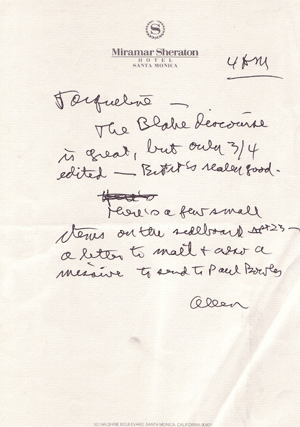
Here's another note written in haste at 4:00 AM or tiredness since it doesn't have a characteristic date. It's probably circa spring/summer of 1994 when I lived next door in Peter Orlovsky's apartment as Allen mentions picking up mail and a "missive" to Paul Bowles on his kitchen sideboard at Apt. 23. I lived there for about six months before moving back to Vermont. Every morning, I would find a bunch of notes slipped under the door.The whole thing reads:

Jacqueline--

The Blake discourse is great, but only 3/4edited-- But it is really good-

There's a few small items on the sideboard Apt 23
a letter to mail + also a missive to send to Paul Bowles

Allen


I remember the Blake piece as he later sent me
a copy of the publication after I was back in
Vermont. I've used it many times for either classes,
papers or lectures on Blake.

It was not unusual for him to leave an opinion/commentary
about someone or something.

Here's such an example dated 5/26/91 asking me to print a photo he took of Alice Denney whom he affectionately refers to as "older lady goofy looking in a big hat w/my photos on wall background." Allen often sent people photos he had taken of them. One of my duties in his office was to organize the photo collection, arrange for printing negatives with either Sid Kaplan or Brian Graham, be the point person for photos in publications, and assist with curating shows. I worked on several large projects such as huge FNAC show that traveled France for a year or so, and many of the stills used in Jerry Aronson's film, Life and Times of Allen Ginsberg. I loved his photos that document for decades both the unknown and known denizens of his world. He had a clear eye for detail and respect for his subjects. My meeting him coincided with his self-consciousness as a photographer in the early 1980's under the tutelage of Robert Frank, Bernice Abbot, and others. He had by then become, a real shutterbug, according to Bernice Abbot, snapping thousands of photos.


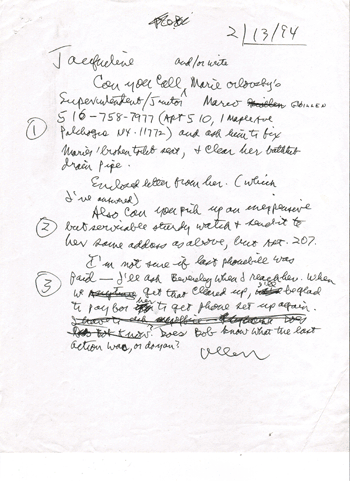
Here's another fairly typical request I used to get from Allen asking me to deal with some domestic crisis--this time on behalf of Marie Orlovsky, Peter Orlvosky's sister. I remember this one well as it took a lot of logistics to get her bathtub drained.

Allen took care of many people on a regular basis such as Gregory Corso, Herbert Hunke, the wonderful poet--Jimmy Schyler, Orlvosky & family, and anyone among his friends who had a basic need. Allen's non-profit, The Committee on Poetry issued modest weekly checks for some who often stopped by the office to collect. Hunke had a funny ingratiating style. Always impeccably dressed, he annoyed me with his complements on what I was wearing--totally phoney, as in those years it was all GAP T-shirts and jeans. Gregory was, well Gregory--mostly rude and ranting or really subdued if he was hurting. As much as he could be so obnoxious, I had a soft spot for Gregory who had a streak of almost Turretsian honesty. He would say the most wounding things. For years he refused actually to say my name because once in Boulder I refused to drive him to Denver to score drugs. He used to refer to me to Allen as the girl with the strange eyes.

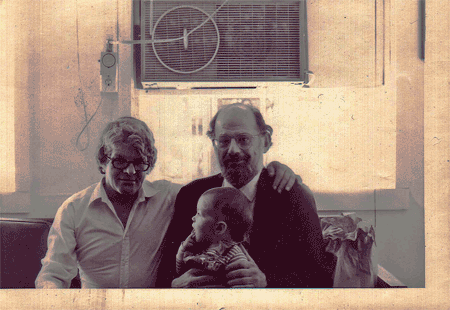
Here's a snapshot I took of Gregory and Allen in my office at Naropa circa 1985 with Gregory's last born son. I was then assistant director of the summer programs with Jane Fiagao who, sadly, died a few years ago from breast cancer. We had fun in that office where a steady stream of faculty and students settled into the ugly black naugahyde couch opposite our desks. Once when two phones rang simultaneously on my desk, Phil Whalen sitting on that couch told me to "breathe" before I picked up the phones.