Showing posts with label Allen Ginsberg. Show all posts

Sunday, November 14, 2010

The Politics of Candor--Why Howl Endures: A Review of Howl the Movie


The film Howl accomplishes much to convey the back story of Allen Ginsberg’s enduring appeal to generation after generation of readers. The film skillfully weaves original transcripts from the 1957 censorship trial, a recreated interview with Ginsberg in his own words (1959 & 1974) with an anonymous journalist, the Gallery Six reading of Howl, and animations of the poem’s text by Eric Drooker, a personal friend of the poet who endorsed his animations.

Not leaving the poem’s legacy to chance, Ginsberg on the occasion of its 30th anniversary in his 1986 introduction to the facsimile edition of Howl sets forth his aesthetic as a manifesto for the primacy of feeling or what Ezra Pound coined, “Only Emotion endures.” There, Ginsberg writes, "The appeal in Howl is to the secret hermetic tradition of art "justifying" or "making up for defeat in worldly life."

Film makers Rob Epstein and Jeffrey Friedman shine a light on the single most turning point of Ginsberg’s fate as a writer, which was not whether or not his signature poem Howl would be blacklisted as ‘obscenity,’ but that Ginsberg would choose the life of his “hearts desire,” which was simply to be himself over the life of the “mad men” he was living at the time (marketing researcher in advertising) —a life of stylish deception, wealth and cultural acceptance over authenticity. With that defining gesture, Ginsberg chose a kind of perpetual freedom ride in the “green automobile”* of his heart’s desire, whether it be with Neal Cassidy, Jack Kerouac, Peter Orlovsky his new found love, or the eternal youths of later years. Ginsberg chose tenderness and likely social failure with what he would later come to call sacred friendships. Ginsberg's notion as portrayed in the interview portion of the film, "That if you could be frank about homosexuality, you could be frank about anything" is at the heart of his aesthetics of candor. The significance of this statement proves the springboard for arguments in favor of the poem's literary merits. The film’s treatment of his homosexuality skillfully conveys Ginsberg’s heroic unfolding to be true to himself which ultimately led to his avocation as a poet.

Unlike many of his contemporaries, Ginsberg did not crash and burn but mustered his considerable intellectual and poetic gifts tirelessly working on behalf of his friends—assembling their manuscripts,promoting the legitimacy of their writing and in some cases supporting them financially. While working for Ginsberg, every year we, his office associates, filed recommendations routinely for poets Gregory Corso and Amiri Baraka to that august institution, The American Academy of Arts & Sciences to join the ranks of Robert Creeley, Gary Snyder and Allen among the established. Ginsberg’s fraternal loyalty remained undying to the end as did his dedication to civil liberties. When I first came to work in his office in 1989, Ginsberg was compiling long affidavits for the ACLU to counter FCC regulations which then banned the poem from being read on public radio although it had previously enjoyed nearly 30 years airtime. On the occasion of the poem's 50th anniversary, WBAI, the most progressive of pacifica public radio stations refused to air the poem.

For me the most affecting aspect of the film is James Franco’s reading of Howl. He captures the subtle nuances of Ginsberg's speech, his tonality and gestures and those oh so juicy Semitic lips that convey, at times, Rabbinic wit and wisdom with the depth of the speaker’s clarion call to truth infused with a moral certitude that the truth sets one free. As a trained poet himself, Franco knows his speaker well and knows how to read a poem—deliberate, rhythmically, and with distinct enunciation entering into the body and mind of the text. He rides the ebb and flow of Ginsberg’s startling imagery as it hurls itself into crescendos of ecstatic speech. Where the human voice falls short, Drooker’s vibrant animation takes over in glowing images reminiscent of Disney's Fantasia that convey the complex meanings. But mostly, Franco gets the poem which is not so much an angry rant but an empathetic howl over the human condition. Howl is above all else a work of immense compassion and Franco conveys this affect perfectly. Like many close associates of the poet, I was prepared to cringe in anticipation of an off-key voice, but Franco pulled it off. I found myself close to tears a number of times. This movie will be around for a very long time.

Late in Life, Walt Whitman summoned the poet of the future.

Poets to come! orators, singers, musicians to come!
Not to-day is to justify me and answer what I am for,
But you, a new brood, native, athletic, continental, greater than
before known,
Arouse! for you must justify me.

I myself but write one or two indicative words for the future,
I but advance a moment only to wheel and hurry back in the darkness.

I am a man who, sauntering along without fully stopping, turns a
casual look upon you and then averts his face,
Leaving it to you to prove and define it,
Expecting the main things from you.

Ginsberg the poet surely delivered on the ‘main things.” The movie, Howl, arouses us to justify the universal bardic voice of great poetry.

Some clips from the movie


As an after thought, there's one more aspect about the film that I very much appreciated. For many years, I worked with Allen's photos in his office. Almost all the set designs remain true to the original photographic record of the period down to every detail, even the texture of fabrics. Ginsberg's extensive archive of photography chronicles the magic of that moment in time before they were "Beats" with a clear and loving eye in homage to his friendships. The movie, Howl, captures hints of the magic for posterity.

*In a class at Naropa, I think it was 1987's spring semester workshop "American Values," Ginsberg said that the poem "Green Automobile" (read here by John Turnbull) was the first poem he wrote in his own voice--a kind of wish list for his "heart's desire" and a precursor to Howl. In the poem with strange prescience he predicts founding a college in the Rocky Mountains.

Wednesday, June 03, 2009

Allen Ginsberg--83rd Birthday, June 3

Garrison Keeler on the Writer's Almanac this morning gave a fine and intelligent homage to Allen on his birthday today, June 3.
The Bard lives on. You can listen to it below.

Monday, April 06, 2009

In Memorium: Allen Ginsberg RIP April 5, 1997


VISITATION
For Allen

A few days later I saw you
seated at a dusty crossroad
looking toward a vista of waterways
reminiscent of a cranberry bog or saltwater marsh,
maybe the river Styx.
A geography of immensity without habitation
where you sat on an old wooden stool,
with books and papers, focused intently.
One familiarity—your Calvin Klein
Goodwill navy blazer, my favorite;
your pens poking out from the pocket.
I stood quietly to your side waiting to assist you
yet not disturb your concentration.
Finished, you handed me a sheaf of papers,
Here, these are for you—for translation.

Then, you got up and walked slowly down the left-hand road.
I followed but you turned to me and said,
This is as far as you are allowed to go, I don’t have the water rights
for your passage—
a hitch of sadness in your voice,
your face mostly impassive, Bell’s Palsy,
one eye bigger, your face a bit cock- eyed,
but looking straight on
as we finished our business together once again
in clarity and respect, our natural elegance
hanging there a second
as we stared at one another.
I watched you walk off and knew you were finally gone.


Text from Primo Pensiero by Jacqueline Gens
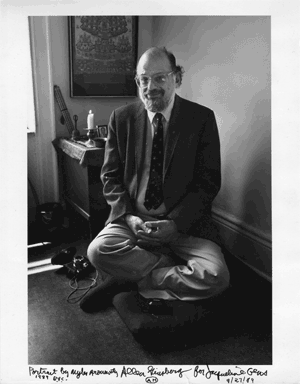
Photo by Myles Aronowitz, 1984

Thursday, June 05, 2008

Happy Birthday Allen Ginsberg!


On June 3, 2008, Allen would have been 82 year old. The kousa dogwood tree planted in his honor in the courtyard at St. Mark's Church in the Bowery is flowering. Remembering the bard, here!

Photo Credit: Bob Rosenthal/Allen Ginsberg Trust

Friday, April 04, 2008

April 5th Anniversary of Allen Ginsberg's Death

When aked how he wanted to be remembered, Allen said, "Father Death Blues"

ALLEN GINSBERG 1926-1997


Father Death Blues


Hey Father Death, I'm flying home
Hey poor man, you're all alone
Hey old daddy, I know where I'm going

Father Death, Don't cry any more
Mama's there, underneath the floor
Brother Death, please mind the store

Old Aunty Death Don't hide your bones
Old Uncle Death I hear your groans
O Sister Death how sweet your moans

O Children Deaths go breathe your breaths
Sobbing breasts'll ease your Deaths
Pain is gone, tears take the rest

Genius Death your art is done
Lover Death your body's gone
Father Death I'm coming home

Guru Death your words are true
Teacher Death I do thank you
For inspiring me to sing this Blues

Buddha Death, I wake with you
Dharma Death, your mind is new
Sangha Death, we'll work it through

Suffering is what was born
Ignorance made me forlorn
Tearful truths I cannot scorn

Father Breath once more farewell
Birth you gave was no thing ill
My heart is still, as time will tell.


These days I am reminded that Allen spent three months in China in 1984, some years before Tiananmen Square. He taught some of the greatest writers of that time at several universities.The transcripts of his lectures in China on American Poetics prepared by Randy Roark are incredible. Wherever he went he made a difference.

For further comments about Ginsberg's Mind Writing Slogans go to my dharma blog,Advice from Abushri.

Wednesday, August 01, 2007

Robin Kornman (1947-2007) Translator of Gesar of Ling

Professor Robin Kornman, reknowned Tibetan translator and scholar of the Tibetan Gesar of Ling epic died peacefully on July 31 after a long illness. Robin was a life-long student of the late Tibetan master, Chogyam Trungpa, founder of Naropa University, whom he met in his youth. As a translator of Tibetan literature, Robin was part of the Nalanda translation team who worked on The Rain of Wisdom, one of the first collections of Tibetan poetry translated into English.

For decades Robin devoted his life to working on translating the
Gesar of Ling epic
, the longest epic in world literature believed to be over 1000 years old and still widely performed through out Central Asia. While a number of translations exist of the Gesar epic, Robin's unique gift and exacting scholarship rivals many of these translations. For an exquisite taste of his elegant language, click here, to access some examples. The Gesar of Ling represents a living Heroic epic cycle where the forces of good and evil are played out in the human realm. In Robin's own words:

The Tibetan Epic of Gesar of Ling is an immense oral epic which is still sung by bards. It exists in literally hundreds of volumes, some of them transcriptions of bardic performances, others original compositions.

The Gesar is a vast treasury of Inner Asian literary culture. It is still sung today in Tibet and is known in different languages and editions along the Silk Route and throughout the Far East. It contains long sections of prose narration alternating with hundreds of epic ballads and examples of every sort of poetry in the Tibetan repertoire, both folk and classical. In size it is like The Arabian Nights. In its breadth, unity, and seriousness, it is like the Homeric epics or the Mahabharata.
It tells the story of a enlightened warrior named Gesar. At the beginning of the epic he is a Buddhist deity named Good News, living peaceably in a Buddhist heaven. The Tibetan tantric sorceror, Padmasambhava, and the bodhisattva of compassion, Avalokiteshvara, attempt to involve him in worldly affairs. These events are reported in the extremely metaphysical first volume of the epic, the Lha gLing or The Divine Land of Ling.


During the years I worked for the poet, Allen Ginsberg, Robin met with Allen on a number of occasions for feedback on his translations into English. For a fine article on Robin, read Larry Mermelstein's recollection.

Saturday, April 14, 2007

Allen Ginsberg's Last Three Days

This year I missed the April 4, 1997 10th Anniversary of Allen's death. Here's a link to Jonas Mekas' home movie.

Father Death Blues (Don't Grow Old, Part V)

Hey Father Death, I'm flying home
Hey poor man, you're all alone
Hey old daddy, I know where I'm going

Father Death, Don't cry any more
Mama's there, underneath the floor
Brother Death, please mind the store

Old Aunty Death Don't hide your bones
Old Uncle Death I hear your groans
O Sister Death how sweet your moans

O Children Deaths go breathe your breaths
Sobbing breasts'll ease your Deaths
Pain is gone, tears take the rest

Genius Death your art is done
Lover Death your body's gone
Father Death I'm coming home

Guru Death your words are true
Teacher Death I do thank you
For inspiring me to sing this Blues

Buddha Death, I wake with you
Dharma Death, your mind is new
Sangha Death, we'll work it through

Suffering is what was born
Ignorance made me forlorn
Tearful truths I cannot scorn

Father Breath once more farewell
Birth you gave was no thing ill
My heart is still, as time will tell.

Allen Ginsberg

Sunday, October 01, 2006

Past Green Woods

Yesterday, I traveled up north to St. Johnsbury with Bill Morgan and Peter Hale to visit Peter Orlovsky whom I hadn't seen in over a decade. Peter O whose health is fragile was lucid and sweet tempered. We were all impressed how well he is doing under the circumstances and the great support system he has within the Shambhala community around Karma Choling. Peter lives in a pleasant house down the street from St. Johnsbury's historic district and the Athenaeum; America's oldest unaltered gallery space that we visited before meeting Peter and his attendant, Michael, for lunch. Prayer flags were fluttering on the porch and the house had great light and simplicity. You can see from the photo that Peter (right) enjoyed the visit. That's Bill Morgan in the background and Peter Hale, on the left.

Bill brought along and gave me his newest publication, a literary biography on Allen called, "I Celebrate Myself, The Somewhat Private Life of Allen Ginsberg." He also brought to give to Peter O, the gorgeous publication of Allen's earliest journals he edited with Juanita Lieberman, an old girlfriend of Peter Orlovsky. As the Allen Ginsberg Trust archivist, Bill probably knows more than anyone about the details of Allen's life having meticulously catalogued every piece of paper and artifact for decades. One interesting aspect about the biography is that he annotates the external events with poems and journal entries next to the narrative of events in the text body, which will prove invaluable to future scholars. I had forgotten about the huge fight between Peter and Ronnie Laing and how Allen and I had cleaned up the Naropa townhouse afterwards, an event Bill mentions in the book. All those Naropa summers seem to merge into another life. It usually takes some kind of trigger for me to remember the rich display of those years.

But I do remember a funny dinner party at Anne Waldman's after the Orlovsky/Laing confrontation with Bill Burroughs, Philip Whalen, a Japanese scholar, Soiku Shigematsu, (Allen for some reason not there) and Reed Bye where Burroughs was really interested in the story about Peter and Ronnie Laing-- grilling me intensely about it. Burroughs seemed to take great delight that Laing was wildly out of control. In the middle of that dinner, Philip fell backwards in his chair tipping over his wine glass that, in turn, triggered a domino effect of chaos all landing in the lap of Mr. Shigimatsu. It was the strangest thing, as though in slow motion. Anne then supplied the gentleman with a pair of her colorful Japanese pants since he was drenched whereupon we all resumed our dinner. For sometime afterwards, Anne and I always had a good laugh over that dinner hoping Mr. Shigimatsu recovered from the ordeal and Philip's mind-stopping behavior that undercut the conversation about Peter and Ronnie Laing.

On the way back from St. Johnsbury, we stopped at Karme Choling briefly which Peter Hale hadn't visited since Trungpa's cremation twenty years ago when he traveled as a young man with Allen and Peter O in the blue Volvo to Vermont from NYC. During that drive home, Allen wrote his wonderful poem about Trungpa's cremation that Peter Hale ( the young man in the poem) recited a bit of...

"...I noticed the path downhill, noticed the crowd moving toward buses
I noticed food, lettuce salad, I noticed the Teacher was absent,
I noticed my friends, noticed our car the blue Volvo, a young boy
held my hand
our key in the motel door, noticed a dark room, noticed a dream
and forgot, noticed oranges lemons & caviar at breakfast,
I noticed the highway, sleepiness, homework thoughts, the boy's
nippled chest in the breeze
as the car rolled down hillsides past green woods to the water,
I noticed the houses, balconies overlooking a misted horizon,
shore & old worn rocks in the sand
I noticed the sea, I noticed the music, I wanted to dance."

--from AG, "On Cremation of Chogyam Trungpa, Vidyadhara"

Tuesday, September 26, 2006

A Few Missives from Allen Ginsberg

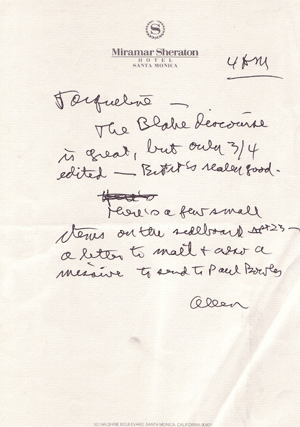
Here's another note written in haste at 4:00 AM or tiredness since it doesn't have a characteristic date. It's probably circa spring/summer of 1994 when I lived next door in Peter Orlovsky's apartment as Allen mentions picking up mail and a "missive" to Paul Bowles on his kitchen sideboard at Apt. 23. I lived there for about six months before moving back to Vermont. Every morning, I would find a bunch of notes slipped under the door.The whole thing reads:

Jacqueline--

The Blake discourse is great, but only 3/4edited-- But it is really good-

There's a few small items on the sideboard Apt 23
a letter to mail + also a missive to send to Paul Bowles

Allen


I remember the Blake piece as he later sent me
a copy of the publication after I was back in
Vermont. I've used it many times for either classes,
papers or lectures on Blake.

It was not unusual for him to leave an opinion/commentary
about someone or something.

Here's such an example dated 5/26/91 asking me to print a photo he took of Alice Denney whom he affectionately refers to as "older lady goofy looking in a big hat w/my photos on wall background." Allen often sent people photos he had taken of them. One of my duties in his office was to organize the photo collection, arrange for printing negatives with either Sid Kaplan or Brian Graham, be the point person for photos in publications, and assist with curating shows. I worked on several large projects such as huge FNAC show that traveled France for a year or so, and many of the stills used in Jerry Aronson's film, Life and Times of Allen Ginsberg. I loved his photos that document for decades both the unknown and known denizens of his world. He had a clear eye for detail and respect for his subjects. My meeting him coincided with his self-consciousness as a photographer in the early 1980's under the tutelage of Robert Frank, Bernice Abbot, and others. He had by then become, a real shutterbug, according to Bernice Abbot, snapping thousands of photos.


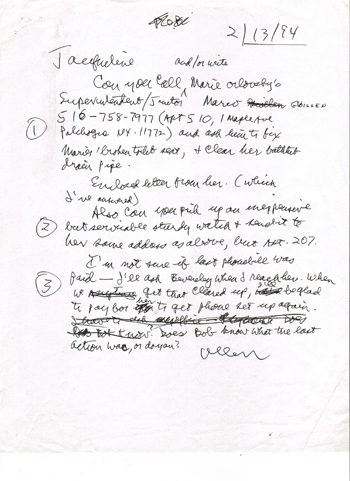
Here's another fairly typical request I used to get from Allen asking me to deal with some domestic crisis--this time on behalf of Marie Orlovsky, Peter Orlvosky's sister. I remember this one well as it took a lot of logistics to get her bathtub drained.

Allen took care of many people on a regular basis such as Gregory Corso, Herbert Hunke, the wonderful poet--Jimmy Schyler, Orlvosky & family, and anyone among his friends who had a basic need. Allen's non-profit, The Committee on Poetry issued modest weekly checks for some who often stopped by the office to collect. Hunke had a funny ingratiating style. Always impeccably dressed, he annoyed me with his complements on what I was wearing--totally phoney, as in those years it was all GAP T-shirts and jeans. Gregory was, well Gregory--mostly rude and ranting or really subdued if he was hurting. As much as he could be so obnoxious, I had a soft spot for Gregory who had a streak of almost Turretsian honesty. He would say the most wounding things. For years he refused actually to say my name because once in Boulder I refused to drive him to Denver to score drugs. He used to refer to me to Allen as the girl with the strange eyes.

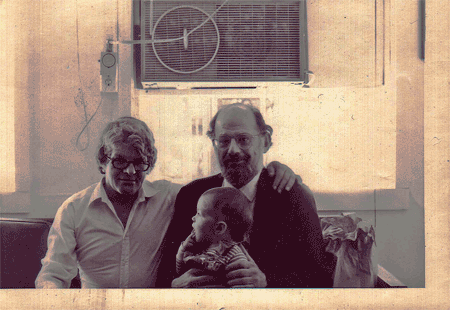
Here's a snapshot I took of Gregory and Allen in my office at Naropa circa 1985 with Gregory's last born son. I was then assistant director of the summer programs with Jane Fiagao who, sadly, died a few years ago from breast cancer. We had fun in that office where a steady stream of faculty and students settled into the ugly black naugahyde couch opposite our desks. Once when two phones rang simultaneously on my desk, Phil Whalen sitting on that couch told me to "breathe" before I picked up the phones.

Wednesday, August 02, 2006

Classical Plastic


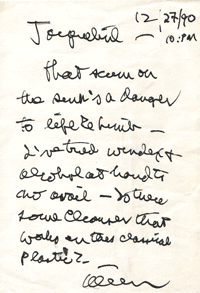
Looking for some transcripts for my thesis, came upon my stash of hundreds of notes from Allen saved from 1984-1994 beginning at Naropa and then for the five years I worked for him in his NYC office. Some like this one are funny in their office domesticity. This note is refering to the faux plastic marble sink in the Union Square office hidden away in a closet. My cat's water dish is made of a similar material and often feels slimy. I like his reference to classical plastic,ever the poet speaking.

Once in Boulder, Allen stayed at my house (actually Martha Bonzi's house where I lived) for one of his Spring Naropa visits. One day he took a message for me on the phone leaving a note. When I got home from work, I found the note and threw it away crumbled up in the nearby bathroom waste basket. Allen must have retrieved it because later it resurfaced when he told me that I might want to save anything with his handwriting. From then on, I saved everything he ever wrote me with direct address. I have close to 400 Dear Jacqueline notes. I thought of selling them but that doesn't really agree with me. Will probably send them to Stanford with all his other material. But it's fun to look them over as a triger for recollection.

Saturday, June 03, 2006

Allen Ginsberg's 80th Birthday Today!

Allen Ginsberg would have been 80 years old today. Nearly a decade after his death (the same day his teacher Chogyam Trungpa died), Allen continues to inspire and irritate with his signature combination of candor and wholehearted compassion through his enduring legacy. Poet, teacher, friend, Buddhist practitioner, political avatar, Ginsberg remains one of the great American minds in promoting a saner world.


Today by coincidence is also the birth of the Buddha celebrated universally as a day when one's actions and thoughts are multiplied millions of times. So, think positive thoughts, write a poem, reflect kindly on the bard who inspired so many of us.

Five A.M.

Elan that lifts me above the clouds
into pure space, timeless, yea eternal
Breath transmuted into words
Transmuted back to breath
in one hundred two hundred years
nearly Immortal, Sappho's 26 centuries
of cadenced breathing -- beyond time, clocks, empires, bodies, cars,
chariots, rocket ships skyscrapers, Nation empires
brass walls, polished marble, Inca Artwork
of the mind -- but where's it come from?
Inspiration? The muses drawing breath for you? God?
Nah, don't believe it, you'll get entangled in Heaven or Hell --
Guilt power, that makes the heart beat wake all night
flooding mind with space, echoing through future cities, Megalopolis or
Cretan village, Zeus' birth cave Lassithi Plains -- Otsego County
farmhouse, Kansas front porch?
Buddha's a help, promises ordinary mind no nirvana --
coffee, alcohol, cocaine, mushrooms, marijuana, laughing gas?
Nope, too heavy for this lightness lifts the brain into blue sky
at May dawn when birds start singing on East 12th street --
Where does it come from, where does it go forever?

Allen Ginsberg from Death and Fame

In this BBC interview, Ginsberg sings "Father Death Blues" which he says is the work he wants to be remembered for.

Friday, May 05, 2006

from Hoppinjohn to East 12th Street, NYC

Hoppinjohn is a classic Southern dish made with black-eyed peas, rice, and ham or ham hock. It was served as a complete protein meal in poorer households and eventually as a celebratory dish on New Year’s Day. There must be hundreds of Hoppinjohn recipes. Most recipe books indicate Hoppinjohn refers to imaginary little Johnny hoppin' his way to the dinner table. But there are other etymological origins such as its Caribbean derivation or that the combination of ingredients had African roots. Hearing Muddy Waters, the other day on Dylan's theme time radio show got me thinking about Hoppinjohn and the Mississippi delta of his origins.

As a child my mother and I drove through Mississippi with my older half-brother, Charles, in the early 1950's where we heard cotton pickers singing in the fields. That road trip is among my earliest memories. Going over the Mississippi River, we were involved in an accident. That's the first time I tasted a life-saver when a policeman handed me one through the car window.

Great Culinary classics almost always derive from ordinary people. You even see this in classic French cuisine. The renowned chef, Henri Charpentier for whom my father, Alexander Pierre Gens worked at the Cafe de Paris in Chicago circa 1930's in his classic Food & Finesse: The Bride's Bible, the first French culinary book widely distributed in America, must have had dozens of recipes for scrambled eggs naming them after famous Americans.

I was first introduced to Hoppinjohn by Marty Brennan-Sawyer at the Putney School where I cooked from 1996-98. Putney School is where I met my colleague who is also a poet, Chard deNiord, with whom I now co-direct the New England College MFA Program in Poetry. On and off over the years, I've cooked professionally or to supplement my income.

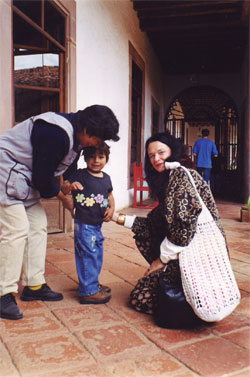
For awhile, Chard and I, ran some poetry programs for the Great River Arts Institute in Patzcuaro, Mexico called "The Spirit & the Letter" with Tom Lux, Heather McHugh, Jerry Stern, Ellen Bryant Voight, Joanne Kyger, Jane Miller and Anne Waldman, who all visited at one time or another. Every morning, I made breakfast for all the poets after shopping in the colorful market and local bakery around the corner from 17 Ibarra Street, the address of our hacienda in Patzcuaro. Jerry Stern still mentions the scrambled eggs I made each morning. You’d think that was the only thing I knew how to cook! After breakfast, everyone would convene for writing workshops followed by the daily comida prepared by Esperanza, the housekeeper at Casa Don Miguel. Here Anne Waldman is with Alexandro and her mother. Lupe, one of the Puerepecha staff employed in running the house.

Casa Don Miguel is a huge hacienda, the length of a football field with four inner courtyards surrounded by rooms on one side. Built in the late 18th century, it was originally a nunnery. Casa Don Miquel was owned by Michael and Vladina Pavlik whose sons went to Putney School. At one point, they approached Chard asking if he would be interested in making an artists colony in Casa Don Miguel. Once I got involved, I was amazed to realize that the town of Patzcuaro was the place where the late Tibetan master, Chogyam Trungpa, my first Buddhist teacher, received many of his terma teachings for Shambhala, particularly his Werma sadhana practiced within the Shambhala Community. Today, Casa Don Miguel is owned by the Catholic school next door to 17 Ibarra Street. But for a couple of years I traveled several times each year to run programs. In the photo above, Ellen Bryant Voight is teaching a workshop in front of the fireplace, where by night, she entertained us with great stories and poetry gossip. She and her husband, Fran, were delightful guests.


During our first Spirit and the Letter Conference in 1999, I made a point of visiting Casa Werma, the house Trungpa’s family still owned in Patzcuaro. Close to the market, it is a small casa surrounded by an astonishing five acres of gardens. Deep into the property there were several smaller structures including a traditional Tarascan house on stilts. I stayed at Casa Werma several days prior to the conference and was appalled at the weird vibes and general strangeness of the place. Later, I discovered that the caretaker was running a brothal out of the house. As a testimony to its partying heritage, there was a huge glass heap of liquor bottles in the backyard. Another quality of Casa Werma was the almost incessant radio station playing 24 hours a day at the garage next door. hardly the contemplative environment I had envisioned. There was also a strange housekeeper who gave us the creeps, whom we later learned from the gardener was a local currandero. The movie, "Rough Magic” was filmed in the town of Patzcuaro and around Lake Patzcuaro which somewhat gives the flavor of the place as both a traditional colonial town but also a powerspot--a corridor into other dimensions, one senses on the subtle level.


All the years I worked at Naropa in the 1980's, I moonlighted cooking part time at a sorority and catered a lot of poetry events for the Jack Kerouac School. My first job at Naropa was cooking for the Kappa Sigma residence during the 1984 Summer session. That was the year Allen broke up with Peter Orlovsky who moved back to New York with his girlfriend, Juanita Lieberman. Allen feeling a bit forlorn used to walk over to the Kappa Sigma and eat dinner with the poetry students. Sometimes Bob Creeley joined him. Here's a photo Allen took of Creeley at the Kappa Sigma dining table.

That's really where I got to know Allen. I don't think he figured out until much later that I was part of the Naropa scene--then a student in the Buddhist Studies department. Every night after his meal, he would bring his dishes into the kitchen and wash them chatting, asking me questions thinking I was just a local girl working in the kitchen. One of the Naropa faculty, Fiz Harwood, told me that he was astonished when she told him I had a degree in Classics from Smith. I have to say that this sense of inquisitiveness was one of Allen's most endearing qualities. Some people feel that he was a misoginist but, in fact, he was immensely curious about all sorts of people--both women and men. I was always so impressed by his good manners. I guess, in my book, after long years working in bars and restaurants, you come to size up people's character quickly based on how they treat the hired help. Well, Allen got my OK early on from those initial contacts in the Kappa
Sigma kitchen. In my experience, the only other person, of note, who matched his good manners and depth of connection was the Benedictine monk, David Stendl-Rast who stayed that same season at KS for Naropa's annual Christian/Buddhist Conference prior to the poets.

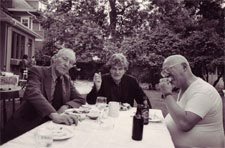
Here's a photo of three ilustrious beat authors chowing down on a lunch I made in honor of William Burroughs at the 1000 Mapleton Avenue house lent to Naropa for the summer of 1985 by Allen's old Columbia friend, David Padua. I spent eight weeks in the house living with a vairety of poetry faculty including Allen, Philip Whalen, and Nanao Sakaki. My favorite was Philip Whalen, a marvelous man with a totally interesting mind. I was very sorry when he died in 2002. He used to occasionally scare me creeeping up behind me and yelling some mantric sounding syllable tha tmade me jump. Later, after I had more training in Vajrayana Buddhism, I understood that he was creating an experience, the Tibetan's call "hedewa," a kind of shock that introduces one to primordial mind free from concepts. I also had a really strong connection with Philip dharmically. once when he was about to undergo open heart surgery, I had some powerful experiences while doing long-life practices for him. Some years later, after he had died and I was having a very difficult time with lots of obstacles in my life, I dreamt that Philip came to my aid reciting protective mantras and dispelled the negativity. I always felt that he was reciprocating my good intentions for him while ill. I only mention all this because it is possible to have an internal connection with someone with whom there is little actual contact. In retrospect, I'm very sorry I didn't pay him more attention although he made a number of overtures. He had a great mind, nor did he repress his emotions which sometimes ran from childish to downright tempermental. To read what it was like to be around him towards the end of his life, Randy Roark wrote a great essay. Michael Rothenberg also wrote about Philip's last year in his collection of poems,

During that summer of 1985, Philip had an attendant stay with him at the Mapleton house. Each evening they cooked up huge meals with pieces of beef the size of the BBQ surface. I read somewhere that Philip said the only thing his friends could not forgive was that he was "fat." But it was always fun to be around him as you never knew what he was going to say or do.

Later, once I got to know Allen and started working for him, it was amazing to see how he connected with people. Cab drivers were especially prone to his inquisitive inquiries. I was with him on that ride Bob Rosenthal writes about somewhere when he yelled, "Fuck Allah" to a Muslim cab driver only to engage the fellow in interesting conversation after getting a rise from him.

Once at Naropa around 1988, several prominent Indian poets came to visit as part of their tour organized by the Committee on Poetry, Allen’s non-profit organization to support poets. They represented a number of different language and religious groups. All of them gave long testimonials to Allen whom they credited for revitalizing Indian poetics by introducing a modernism and a more cosmopolitan aesthetic. One of the poets told a story about how Allen at a coctail party in the early 1960's while in conversation with the Minister of Finance or Economy, said he really liked his native Indian garb suggesting that American young people might like it too—thus, in a sense, planning a seed for revitalizing India’s economy as well through exporting Indian clothing catering to the hippie culture of the times.

As many people experienced, being a guest at Allen's table could be charming. Until he got the office on Union Square around 1991, for a couple of years, every day I picked up his mail at Stuyvesant Station and then delivered it to his 437 East 12th Street apartment around the corner to sort through it with him. Allen, still inhis pajamas ( the yellow pair) would be getting up around 10-11: 00 AM when he would put out breakfast often inviting me to join him.

There were almost always guests—poets, translators, journalists, old friends. A typical spread would include low-fat Alpine cheese, olives, good bread, sometimes boiled eggs, or kanji, iceberg lettuce with his family’s salad dressing recipe made with sugar in a white vinaigrette, fresh fruit-- like mango, papaya, or melon, and herb tea.

Wednesday, May 03, 2006

Hey, Allen--The Sun is Shining: Bob Dylan on Xm Radio

It’s already been a month since Glen died. On April 4th, the previous night, I had visited the local Shambhala Center in Brattleboro a few blocks from my house to celebrate the 'parinirvana' of Chogyam Trungpa, also the day Allen died nearly ten years ago. He’s been on my mind lately so decided to include “Visitation” in my forthcoming chapbook I've been working on:

VISITATION
For Allen

A few days later I saw you
seated at a dusty crossroad
looking toward a vista of waterways
reminiscent of a cranberry bog or saltwater marsh
I once visited, maybe the river Styx.
A geography of immensity without habitation

where you sat on an old wooden stool,
pored over books and papers, focused intently.
One air of familiarity—your Calvin Klein
Goodwill navy blazer, my favorite;
your pens poking out from the pocket.
I stood quietly to your side waiting to assist you
yet not disturb your concentration.
Finished, you handed me a sheaf of papers,
Here, these are for you—for translation.

Then, you got up and walked slowly down the left-hand road.
I followed but you turned to me and said,
"This is as far as you are allowed to go, I don’t have the water rights
for your passage" —
a hitch of sadness in your voice, your face mostly
impassive, Bell’s Palsy, making one eye bigger, your face a bit cock-eyed,
but looking straight on as we finished our business together once again
in clarity and respect, our natural elegance hanging there a second
as we stared at one another.
I watched you walk off and knew that you were finally gone
on some other journey, to some other place.


Dylan's theme-time radio show debut yesterday morning on XM radio's Deep Tracks station delivered the kind of smarts, warmth, and expansive presence so absent in current media. We're not talking here about a quaint ole time radio show like "Prairie Home Companion" but a magnanimous reach for the underbelly of American music-- Harry Smith at Allen's kitchen table circa 1988

"Old Weird America," folk scholar, Harry Smith called it. Don't let Dylan's folksy accent kid you. He's erudite and comfortable with it too. His consonants sounded as crisp as ever. Dylan, if nothing else, is a master of elocution. Listening on that dank and rainy spring day in Brattleboro to Dylan's show on "Weather" with him asking the audience if it was raining here too was a bit of magical synchronicity.

I'm sorry Allen isn't around to experience Dylan's graceful shift into old age--the "Chronicles", "Masked and Anonymous", "No Direction Home", now his theme-time weekly radio show on XM. Seeing Dylan at last coming to terms with his fame would have eased his mind as he worried that Dylan found it all too concrete unlike himself. During the years I worked for Allen, there were many precious moments but one of the two times I wished I had a tape recorder was on my 40th birthday when Allen made dinner for me (or rather Jack Shiu did) inviting friends Ellen Pearlman and her Tibetan husband, Tsonam, to join us squeezing us all around his four-sqaure kitchen table in the East 12th Street apartment. That night, he played host bearing books to the dinner table to introduce Tsonam to Cezanne. Later after the guests left, Allen started playing Dylan records--all of them for hours, commenting on phrases here or there he thought especially exquisite. Here's where I wish I had the tape recorder or took notes. [the other time was driving with Edith Ginsberg, Allen and Bob Rosenthal around Patterson]. He loved Dylan, I think more than anyone--for his brilliance. In "No Direction Home", Allen's commentary is heart breaking. Seeing him already so ill-looking was a shock. His comments about Dylan as a "receiver" were faithful to his long recognition of Dylan's literary genius which he perceived as amounting to a quintiessential archytype for poetrymind.

In the office, we were always a bit amused how unusually "ga-ga" Allen would get when talking with Dylan on the phone.As far as I know, Dylan was the only one who commanded such reverence. For our pleasure, Allen would put their calls on speakerphone. Late in 1994, after work one night he took me with him to a concert at the Beacon Theater where we went back stage. In previous years, Bob Rosenthal and Peter Hale had the privilege. One of the telling signs about Dylan is that his staff has worked with him for years. Diane Lapson, one of the co-producers of the radio show, brought us back stage where that particular show Dylan wasn't seeing many people. That might have been the last time they saw each other, I'm not sure. Bob Rosenthal woould know as I left NYC about two years before Allen died. Somehow that event made it into Barry Miles revised bio from a journal entry Allen made later that night....they had bantered back and forth about—Gregory Corso, Blake, the room was dark and lit with a candle with Dylan sitting on the floor and Allen in the only chair. Did I imagine this? The first thing you notice about Dylan is just how smart he is. At one point, Allen said to Dylan something like, "“If you want to know about Buddhism, ask her" which embarrassed me. Dylan laughed harshly saying something about a laughing Buddha bar in Kansas City. I must have jumped or reacted in some way because then Dylan flashed his dazzling smile, the same one his audience would get a momentary glimpse of at the end of his set later that night at the Beacon--—a few seconds of blazing sunshine, a gift from the poetry muses or devas and dakinis we mortals can only take in small increments. Yes, the sun is shinning these days...Thanks, Bob & Company. Hope Harry, Allen, Gregory and all our departed are taking a break to tune in!

See You Later, Allen Ginsberg

Photo credit copyright by Dale Smith, 1965 at TEXT
Photo creditof Harry Smith by Allen Ginsberg circa 1988

Friday, February 18, 2005

Allen Ginsberg's 108 Mind Writing Slogans

Allen began compiling these during the time I worked for him in NYC circa 1989-1994. They follow the traditional Buddhist tripartite logic of Ground, Path, & Fruition. A precursor to the "Mind Writing Slogans" can be found in his poem,
"Cosmopolitan Greetings."

These slogans introduce both a western contemplative persepctive on mind training for poets as well as Buddhist methods learned by the poet from various Tibetan masters he studied with. Gibnsberg's "Mind Writing Slogans" present an essentialized version of his poetic aesthetic.

ALLEN GINSBERG

MIND WRITING SLOGANS

"First Thought is Best in Art, Second in Other Matters."
— William Blake

I Background (Situation, Or Primary Perception)

1."First Thought, Best Thought" — Chogyam Trungpa, Rinpoche
2."Take a friendly attitude toward your thoughts." — Chogyam Trungpa, Rinpoche
3."The Mind must be loose." — John Adams
4."One perception must immediately and directly lead to a further perception." — Charles Olson, "Projective Verse"
5."My writing is a picture of the mind moving." — Philip Whalen
6.Surprise Mind — Allen Ginsberg
7."The old pond, a frog jumps in, Kerplunk!" — Basho
8."Magic is the total delight (appreciation) of chance." — Chogyam Trungpa, Rinpoche
9."Do I contradict myself? Very well, then I contradict myself. I am large. I contain multitudes." –– Walt Whitman
10."...What quality went to form a man of achievement, especially in literature? ... Negative capability, that is, when a man is capable of being in
uncertainties, mysteries, doubts, without any irritable reaching after fact & reason." — John Keats
11."Form is never more than an extension ofcontent. — Robert Creeley to Charles Olson
12."Form follows function." — Frank Lloyd Wright*
13.Ordinary Mind includes eternal perceptions. — A. G.
14."Nothing is better for being Eternal
Nor so white as the white that dies of a day." — Louis Zukofsky
15.Notice what you notice. — A. G.
16.Catch yourself thinking. — A. G.
17.Observe what’s vivid. — A. G.
18.Vividness is self-selecting. — A. G.
19."Spots of Time" — William Wordsworth
20.If we don’t show anyone we’re free to write anything. –– A. G.
21."My mind is open to itself." — Gelek Rinpoche
22."Each on his bed spoke to himself alone, making no sound." — Charles Reznikoff


II Path (Method, Or Recognition)

23."No ideas but in things." "... No ideas but in the Facts." — William Carlos Williams
24."Close to the nose." — W. C. Williams
25."Sight is where the eye hits." — Louis Zukofsky
26."Clamp the mind down on objects." — W C. Williams
27."Direct treatment of the thing ... (or object)." — Ezra Pound, 1912
28."Presentation, not reference." — Ezra Pound
29."Give me a for instance." — Vernacular
30."Show not tell." — Vernacular
31."The natural object is always the adequate symbol." — Ezra Pound
32."Things are symbols of themselves." — Chogyam Trungpa, Rinpoche
33."Labor well the minute particulars, take care of the little ones.
He who would do good for another must do it in minute particulars.
General Good is the plea of the Scoundrel Hypocrite and Flatterer
For Art & Science cannot exist but in minutely organized particulars." — William Blake
34."And being old she put a skin / on everything she said." — W. B. Yeats
35."Don’t think of words when you stop but to see the picture better." — Jack Kerouac
36."Details are the Life of Prose." — Jack Kerouac
37.Intense fragments of spoken idiom best. — A. G.
38."Economy of Words" — Ezra Pound
39."Tailoring" — Gregory Corso
40.Maximum information, minimum number of syllables. –– A. G.
41.Syntax condensed, sound is solid. — A. G.
42.Savor vowels, appreciate consonants. — A. G.
43."Compose in the sequence of musical phrase, not in sequence of a metronome." — Ezra Pound
44."... awareness ... of the tone leading of the vowels." — Ezra Pound
45."... an attempt to approximate classical quantitative meters . . . — Ezra Pound
46."Lower limit speech, upper limit song" — Louis Zukofsky
47."Phanopoeia, Melopoeia, Logopoeia." — Ezra Pound
48."Sight. Sound & Intellect." — Louis Zukofsky
49."Only emotion objectified endures." — Louis Zukofsky


III Fruition (Result, Or Appreciation)

50.Spiritus = Breathing = Inspiration = Unobstructed Breath
51."Alone with the Alone" — Plotinus
52.Sunyata (Sanskrit) = Ku (Japanese) = Emptiness
53."What’s the sound of one hand clapping?" — Zen Koan
54."What’s the face you had before you were born?" — Zen Koan
55.Vipassana (Pali) = Clear Seeing
56."Stop the world" — Carlos Castafleda
57."The purpose of art is to stop time." — Bob Dylan
58."the unspeakable visions of the individual — J. K.
59."I am going to try speaking some reckless words, and I want you to try to listen recklessly." — Chuang Tzu (Tr. Burton Watson)
60."Candor" —Whitman
61."One touch of nature makes the whole world kin." — W. Shakespeare
62."Contact" — A Magazine, Nathaniel West & W. C. Williams, Eds.
63."God appears & God is Light
To those poor souls who dwell in Night.
But does a Human Form Display
To those who Dwell in Realms of Day." — W. Blake
64."Subject is known by what she sees." -A. G.
65.Others can measure their visions by what we see. –– A. G.
66.Candor ends paranoia. — A. G.
67."Willingness to be Fool." — Chogyam Trungpa, Rinpoche
68."Day & Night / you’re all right." — Gregory Corso
69.Tyger: "Humility is Beatness." — Chogyam Trungpa, Rinpoche & A. G.
70.Lion: "Surprise Mind" — Chogyam Trungpa, Rinpoche &A.G.
71.Garuda: "Crazy Wisdom Outrageousness" — Chogyam Trungpa, Rinpoche
72.Dragon: "Unborn Inscrutability" — Chogyam Trungpa, Rinpoche
73."To be men not destroyers" — Ezra Pound
74.Speech synchronizes mind & body — Chogyam Trungpa, Rinpoche
75."The Emperor unites Heaven & Earth" — Chogyam Trungpa, Rinpoche
76."Poets are the unacknowledged legislators of the world" — Shelley
77."Make it new" — Ezra Pound
78."When the music changes, the walls of the city shake" — Plato
79."Every third thought shall be my grave — W Shakespeare, The Tempest
80."That in black ink my love may still shine bright." –– W. Shakespeare, Sonnets
81."Only emotion endures" — Ezra Pound
82."Well while I’m here I’ll
do the work —
and what’s the Work?
To ease the pain of living.
Everything else, drunken
dumbshow." — A. G.
83."... Kindness, sweetest of the small notes in the world’s ache, most modest & gentle of the elements entered man before history and became
his daily connection, let no man tell you otherwise." — Carl Rakosi
84."To diminish the mass of human and sentient sufferings." — Gelek Rinpoche

Naropa Institute, July 1992
New York, March 5, 1993
New York, June 27, 1993