On the
parchment of diverse red and white phenomena
the bamboo quill of self-existent primal awareness
and Knowledge inscribes baseless
unattached ciphers liberated from the beginning
creating images to be read in the space
of co-emergent appearances and emptiness.
from Song 23
Flight of the Garuda
Thursday, April 07, 2016
Thursday, March 31, 2016
Some Poems by Participants in the Meditation and Writing Workshop
A Few Fibonacci Poems from Sarah Doyle
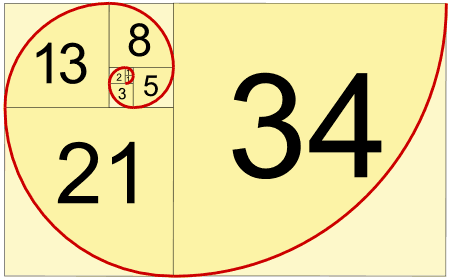
Fibonacci poem (or Fib) is a multiple-line verse based on the Fibonacci sequence so that the number of syllables in each line equals the total number of syllables in the preceding two lines.
Charlie in the Corn:
Darwin at Mike’s Maze
We
were
surprised
to see the
cladistics on the
handout at Mike’s Maze, the grand head
of old Darwin amazed in corn:
myxinformes, dipnoi,
petromyzontiformes, crocodilia,
testudines: What kind of farmer is this?
We tramped slick mud paths among
cornstalks, following trails of thought from form to form, synapse to synapse,
traced the fragile wire of Darwin’s glasses
where they bridged his nose past abrupt,
dead-end paths that marked his forehead’s thoughtful furrows.
From the wavy trails of his beard, exotic
rivers
flowed to Galapagos finches.
His beseeching eyes
sought Down House:
his own
soft
nest.
Bliss
black
dog is
snoring gently on
the bed. Her trust is absolute.
We tell her, “I love you, Poochlie-Boodles. We love you,
Dog-Pie.” We give her treats, rub her belly. We engage in
dog worship, stroking her warm,
hairy little belly. Unmitigated bliss. Sighs.
We envy her. We want bliss, too.
This is as close as
we’re ever
going
to
get.
Charlie in the Corn: Darwin at Mike’s Maze
We
were
surprised
to see the
cladistics on the
handout at Mike’s Maze, the grand head
of old Darwin amazed in corn: myxinformes, dipnoi,
petromyzontiformes, crocodilia, testudines: What kind of
farmer is this?
We tramped slick mud paths among cornstalks, following
trails of thought from form to form, synapse to synapse, traced the fragile
wire of Darwin’s glasses
where they bridged his nose past abrupt, dead-end paths that
marked his forehead’s thoughtful furrows.
From the wavy trails of his beard, exotic rivers
flowed to Galapagos finches.
His beseeching eyes
sought Down House:
his own
soft
nest.
Sarah grew up in Cleveland and lived for many years in Boston/Cambridge, where she worked in college publishing and then freelanced as an editor, proofreader, and book promo writer. In the1990s, she developed an interest in the history of science pursuing it ever since, particularly through the phenomena of posture photographs and the dinosaur footprints of the CT River Valley, which end up having surprising crosscurrents. Presently, she works at Pocumtuck Valley Memorial Association (Deerfield) creating events and a website dedicated to the discovery of dinosaur footprints, and at Independent Living Resources (ILR), a nonprofit working on accessibility for people with disabilities. Her poems are steeped in the local history of Deerfield and her historical interests.
Sarah grew up in Cleveland and lived for many years in Boston/Cambridge, where she worked in college publishing and then freelanced as an editor, proofreader, and book promo writer. In the1990s, she developed an interest in the history of science pursuing it ever since, particularly through the phenomena of posture photographs and the dinosaur footprints of the CT River Valley, which end up having surprising crosscurrents. Presently, she works at Pocumtuck Valley Memorial Association (Deerfield) creating events and a website dedicated to the discovery of dinosaur footprints, and at Independent Living Resources (ILR), a nonprofit working on accessibility for people with disabilities. Her poems are steeped in the local history of Deerfield and her historical interests.


In Memorium: April 5, 2016

VISITATION
for Allen (1926-1997)
A few days later I saw you
seated at a dusty crossroad
looking toward a vista of waterways
reminiscent of a cranberry bog or salt water marsh,
maybe the River Styx.
A geography of immensity without habitation
where you sat on an old wooden stool
with books and papers focused intently.
One familiarity--your Calvin Klein
Goodwill navy blazer, my favorite;
your pens poking out from the pocket.
I stood quietly to your side waiting to assist you
yet not disturb your concentration.
Finished, you handed me a sheaf of papers
Here, these are for you --for translation.
Then, you got up and walked slowly down the left had road.
I followed but you turned to me and said,
This is as far as you are allowed to go, I don't have the water rights
for your passage--
A hitch of sadness in your voice,
your face mostly impassive, Bell's Palsy,
one eye bigger, your face a bit cock-eyed,
but looking straight on
as we finished our business once again
in clarity and respect, our natural elegance
hanging there a second
as we stared at one another.
I watched you walk off and knew you were finally gone.
--Jacqueline Gens
[Published in Primo Penseiro, Shivastan Publishing,Woodstock and Kathmandu, 2008.
[Photo by Myles Aronowitz]
Tuesday, March 29, 2016
Next Meditation and Writing Meeting on Saturday, April 2, 2016

The next meditation and writing workshop will take place at the Shambhala Meditation Center in Shelburne Falls, MA on Saturday, April 2, 2016 11:00 AM-2:00 PM.
The main topic will be our continued explorations of the poetics of uncertainty and Keats' Negative Capability that is to say:
NEGATIVE CAPABILITY – defined by Keats
Negative capability is a theory of the poet John Keats. Keats' theory of "negative capability" was expressed in his letter to George and Thomas Keats dated Sunday, 28 December 1817.
“I had not a dispute but a disquisition with Dilke, on various subjects; several things dovetailed in my mind, & at once it struck me, what quality went to form a Man of Achievement especially in literature & which Shakespeare possessed so enormously - I mean Negative Capability, that is when man is capable of being in uncertainties, Mysteries, doubts without any irritable reaching after fact and reason.
Keats believed that great people (especially poets) have the ability to accept that not everything can be resolved. Keats was a Romantic and believed that the truths found in the imagination access holy authority. Such authority cannot otherwise be understood, and thus he writes of "uncertainties." This "being in uncertaint[y]" is a place between the mundane, ready reality and the multiple potentials of a more fully understood existence.”
Keats expressed this idea in several of his poems:
La Belle Dame sans Merci: A Ballad (1819)
Ode to a Nightingale (1819)
The Fall of Hyperion: A Dream (1819)
Ode on a Grecian Urn (1819)
Negative capability is a state of intentional open-mindedness paralleled in the literary and philosophic stances of other writers. Much has been written about this. Walter Jackson Bate, Keats's authoritative biographer, wrote an entire book on the topic. The footnote to the negative capability letter in the 1958 Harvard UP edition of the Letters of John Keats references the work of Woodhouse, Bate, C. L. Finney, Barbara Hardy, G. B. Harrison, and George Watson, all prior to the edition’s printing in 1958. In the 1930s, the American philosopher John Dewey cited Keatsian negative capability as having influenced his own philosophical pragmatism, and said of Keats' letter that it "contains more of the psychology of productive thought than many treatises." [2] [3] Additionally, Nathan Scott (author of a book titled Negative Capability), notes that negative capability has been compared to philosopher Martin Heidegger’s concept of Gelassenheit, “the spirit of disponibilité before What-Is which permits us simply to let things be in whatever may be their uncertainty and their mystery."
Walt Whitman---from Leaves of Grass
“Do I contradict myself? Very well, then I contradict myself, I am large, I contain multitudes.”
Bring a poem (with copies) to share.
A few notes for walking meditation exercise from notes taken in a workshop with Anne Waldman in Patzcuaro, Mexico (If the weather is great we will take our meditation for the day outdoors) :
1) Act of Observation/Attention – Compassionate engagement with other
2) Act of Observation/Notation –Entre into sacred world as pure perception
(3) Act of Notation/Articulation –Generosity of spirit
4) Poetic Notation– a dot in the continuity of poets past and present
For further information contact Jacqueline at 413-522-1125
Monday, March 21, 2016
RESCHEDULED Lecture May 5, 2016 on The Poetics of Uncertainty with Jacqueline Gens
The Poetics of Uncertainty and Journey to Wisdom
RESCHEDULED for May 5, 2016 in Pittsfield, MA with Jacqueline Gens
Unitarian Church175 Wendell Ave, Pittsfield, MA
6:00 PM For further information call: 413-358-2626 or 508-237-4252
Poetrymind universally has a long tradition of ‘unknowing’ in the sense of thriving within the ground of uncertainty or what poet Fannie Howe calls, “Bewilderment”. The aim here is to write from a non-conceptual and non-judgemental point of view trusting in the authenticity of one’s pure perception leading to an elegant syntax in poetry. The late poet Allen Ginsberg called this "First Thought, Best Thought". In this discussion and Lecture we will examine how such an approach furthers our writing as an act of discovery through looking at noted poems and simple exercises. Open to both beginners and advanced writers.
Jacqueline Gens worked with poets for over thirty years. She was a co-founder of the New England College MFA program in Creative Writing and its co-director for over a decade. For many years she worked for the late poet Allen Ginsberg in NYC and the Naropa Institute. Currently she lives in Shelburne Falls, MA where she is retired and spends time at the Khandroling Paper Cooperative she founded to recycle sacred texts in the Buddhist tradition into calligraphy papers and other uses. To read more about her writing groups and work, visit her blog Poetrymind at www.tsetso.blogspot.
Subscribe to:
Posts (Atom)